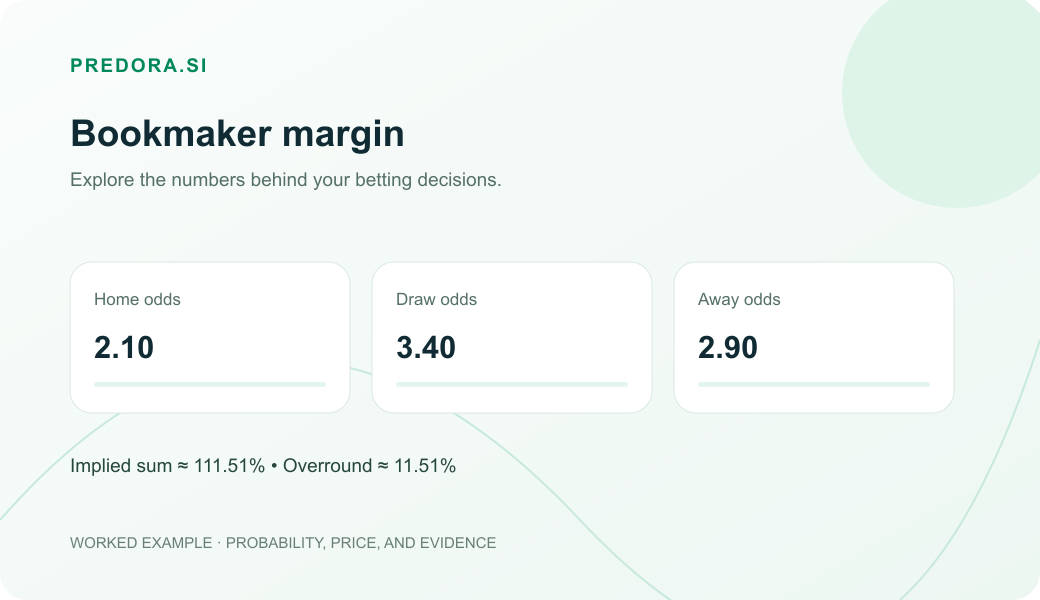
Direct answer
Overround is the sum of the implied probabilities of the odds of all outcomes in a market. When that sum exceeds 100%, the excess shows the bookmaker's built-in margin.
In one sentence: overround is how much the sum of the implied chances of a market's odds exceeds 100%.
Quick summary
| What it measures | The sum of the implied probabilities of a market's odds. |
|---|---|
| Where it shows up a lot | 1x2 market: home, draw, and away. |
| Base formula | Implied probability = 1 ÷ decimal odds |
| Overround formula | Overround (%) = Σ(1 ÷ decimal odd) × 100 |
| Simple reading | If it comes to 103%, the simple built-in margin is about 3%. |
| Common mistake | Thinking that a low overround, on its own, already indicates value. |
| How Predora.si helps | Comparing odds between bookmakers and highlighting the best available odd in the analyzed market. |
Overround is the total of a market's implied probabilities; what exceeds 100% represents the approximate simple margin built into the odds.
How overround works
In a fair market, without bookmaker margin, the sum of the probabilities of all possible outcomes should be 100%. It is just that bookmakers do not set odds like a neutral table: they build margin into the prices.
In football, the simplest example is the market 1x2:
- home team wins;
- draw;
- away team wins.
These three outcomes cover all possibilities in the market. When you convert each odd into implied probability and sum everything, the total usually exceeds 100%. That excess is the margin built into the price.
The higher the overround, the more margin-loaded the market tends to be. That alone does not determine whether value exists, but it improves your reading before comparing odds and estimated probability.
Overround formula
Implied probability = 1 ÷ decimal oddsOverround (%) = sum of implied probabilities × 1001x2 overround = [(1 ÷ odd 1) + (1 ÷ odd X) + (1 ÷ odd 2)] × 100Simple margin (%) = overround (%) - 100%In market usage, some people call the full total overround, such as 103%, and others use the term for the excess, such as 3%. To avoid confusion, here is the reading:
Total overround
The summed total, such as 103%.
Simple margin
The excess above 100%, such as 3%.
Example in football
Imagine a Brasileirão game with these odds in the 1x2 market:
| Outcome | Odds | Implied probability |
|---|---|---|
| Home team wins | 2.00 | 50,00% |
| Draw | 3.40 | 29,41% |
| Away team wins | 4.20 | 23,81% |
| Total | - | 103,22% |
1 ÷ 2.00 = 0.5000 = 50.00% 1 ÷ 3.40 = 0.2941 = 29.41% 1 ÷ 4.20 = 0.2381 = 23.81% Total overround = 50.00% + 29.41% + 23.81% Total overround = 103.22% Simple margin = 103.22% - 100% Simple margin = 3.22%In other words: this market is at about 3.22% simple margin embedded.
That does not mean every price in the market is unfavorable. It only means the odds already carry margin. To assess whether a discrepancy exists, compare that price with an estimated probability.
Overround, bookmaker margin, vig and juice
In practice, these terms live in the same family.
| Term | Practical meaning |
|---|---|
| Overround | Sum of the implied probabilities of a market's odds. |
| Bookmaker margin | The excess above 100%, which represents the fat built into the odds. |
| Vig / juice | English terms used to refer to this margin or built-in cost. |
Overround shows the total.
Margin shows the excess.
Vig and juice are common names for the bookmaker's cut.
How it appears on Predora.si
At Predora.si, overround talks directly to the odds comparison. The app shows odds from different bookmakers for the same game and market, helping you see where the best available odd.
But the main point is: best odd does not automatically indicate value. The mathematical assessment comes from comparing the observed odds with the probability estimated by the Active Model.
1. Overround
Helps understand the margin built into the market.
2. Odds comparison
Helps look for a better price in the same match, market, and line.
3. Active Model
Helps estimate the chance for that outcome or market.
4. EV and edge
Help measure whether an estimated difference may exist.
Common mistake
The most common mistake is thinking that low overround = value.
A lower overround generally means a smaller bookmaker margin. To assess value in a selection, compare its odds with the fair price implied by your probability estimate.
Compare different markets
Comparing 1x2 with 1x2 makes sense. Comparing 1x2 with BTTS mixes different questions.
Compare different lines
Over 2.5 goals and Over 2.75 goals are not the same line.
Stop at the margin
Overround helps read the price, but value depends on estimated probability, fair odd, edge, and EV.
Checklist for interpreting overround
- Identify a market with all outcomes clear, such as 1x2.
- Gather the comparable decimal odds for each outcome.
- Convert each odd into implied probability with
1 ÷ odd. - Sum all implied probabilities.
- Compare the total with 100%.
- If it exceeds 100%, the excess is the approximate simple margin.
- Then compare sources to observe price differences in the market.
- Finally, compare the odd with the estimated probability used.
Start by converting odds into probability. Then compare prices in the same market and use EV to assess whether the odd still makes sense against your own estimate or the Active Model's.
FAQ about overround
Is overround the same thing as bookmaker margin?
Almost. Overround is the sum of a market's implied probabilities. The bookmaker margin is the excess above 100%. In everyday usage, many people use the two terms almost interchangeably.
How do you calculate overround on decimal odds?
Convert each odd into implied probability using 1 ÷ odd, sum all probabilities, and multiply by 100. If the total comes to 104%, the approximate simple margin is 4%.
How does overround relate to value betting?
A lower overround means a smaller bookmaker margin. Evaluate a selection by comparing: estimated probability vs offered odd.
Does overround exist in the 1x2 market?
Yes. 1x2 is one of the easiest examples for understanding overround, because it has three possible outcomes: home, draw, and away.
Does the overround change when the odds change?
Yes. If odds rise or fall, the implied probabilities also change. That is why overround can change over time, especially close to the match.
Next steps
Overround shows that odds are prices with built-in margin. It helps you understand the cost of the market before comparing bookmakers, best odd, and estimated probability.
Use this concept as part of the analysis: first read the margin, then compare odds, and finally assess whether positive EV exists.