Direct answer
EV in betting means Expected Value, or expected value. It's a metric that shows whether a bet tends to be positive or negative in the long run by comparing the estimated probability of an outcome with the offered odds by the bookmaker.
In plain terms: EV helps answer whether the odds are paying well for that chance or just look attractive.
Quick summary
| What is EV? | Expected value of the bet. It measures whether the odds compensate for the estimated probability. |
|---|---|
| Formula | EV = (estimated probability × odds) − 1 |
| positive EV | The odds are paying above what the estimated probability suggests. |
| Negative EV | The odds are paying below the estimated fair price. |
| When to use it? | By comparing the estimated probability with the observed odds. |
| Common mistake | Assessing EV from one match result. |
| How does Predora.si help? | It shows chance, expected value, and the best odds per market using the Active Model. |
EV is the calculation that compares the estimated chance of a bet with the available odds to show whether there is an estimated edge over the long run.
How does EV work in betting?
Every bet has two sides:
- The chance of it happening.
- The price paid by the bookmaker, in other words, the odds.
EV is born from the comparison between these two points. If an outcome has 50% chance, the fair odds would be 2.00. If a bookmaker pays 2.20, it is paying above fair value and positive EV may exist. If it pays 1.80, the price is below fair value and EV tends to be negative.
The logic is simple: high probability alone does not indicate positive EV. The observed price also needs to be compared with the estimated chance.
EV formula in betting
EV = (estimated probability × odds) − 1| Estimated probability | The chance that you or a model assigns to the outcome. It should be used in decimal form. E.g., 55% = 0.55. |
|---|---|
| Odds | The decimal odds offered by the bookmaker. E.g., 2.05. |
| EV Result | The percentage expectation of that bet per unit staked. |
If the outcome is greater than 0, the EV is positive. If it is less than 0, the EV is negative.
Example of EV in a football bet
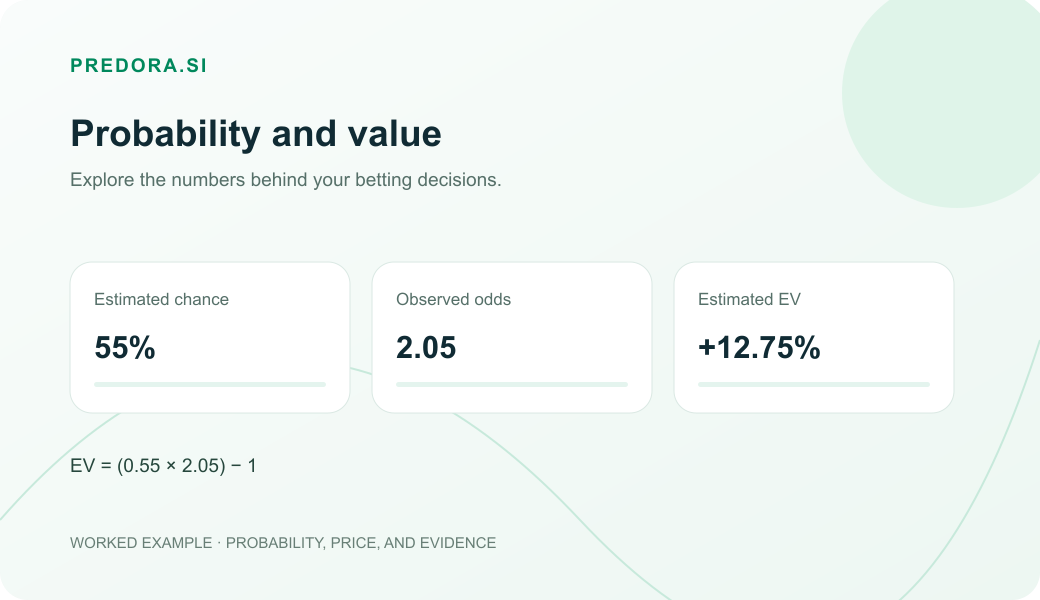
Imagine a Brasileirão game in the market 1x2. The model estimates that the home team has 55% chance of winning, and the best available odds for that win are 2.05.
EV = (0.55 × 2.05) − 1 EV = 1.1275 − 1 EV = 0.1275 EV = +12.75%This means that, according to this estimated probability, the bet has positive expected value of 12.75%.
Under this probability estimate, the price produces a favorable expected average. Compare a series of similar bets to assess how actual results relate to that expectation.
Positive EV: what does it mean?
positive EV, or EV+, happens when the formula result is greater than zero.
EV > 0 = positive EVThis indicates that the odds are paying more than they should, considering the estimated probability.
| Estimated probability | Odds | Calculation | EV |
|---|---|---|---|
| 50% | 2.15 | (0.50 × 2.15) − 1 | +7,5% |
| 55% | 2.05 | (0.55 × 2.05) − 1 | +12,75% |
| 60% | 1.80 | (0.60 × 1.80) − 1 | +8,0% |
This is the kind of situation many people call value bet. The calculation expresses a favorable expected average under the probability estimate used.
Negative EV: what does it mean?
Negative EV happens when the odds do not compensate for the estimated probability.
EV < 0 = negative EV| Estimated probability | Odds | Calculation | EV |
|---|---|---|---|
| 60% | 1.55 | (0.60 × 1.55) − 1 | -7,0% |
| 50% | 1.85 | (0.50 × 1.85) − 1 | -7,5% |
| 45% | 2.00 | (0.45 × 2.00) − 1 | -10,0% |
Here comes a common confusion: a bet can have high probability and still have Negative EV. The chance can be good, but the price may not help.
EV, fair odds, and implied probability
| Concept | What it answers | Formula |
|---|---|---|
| Implied probability | What chance is the bookmaker's odds pricing in? | 1 ÷ odd |
| Fair odds | What odds would be fair for an estimated probability? | 1 ÷ probability |
| EV | Does the offered odds have value for this probability? | (probability × odd) − 1 |
| Edge | What is the difference between my chance and the bookmaker's chance? | model probability − implied probability |
Implied probability translates the bookmaker's odds into a chance. Fair odds translates your estimated chance into a price. EV shows whether the offered price is good or bad. Edge shows the difference between your reading and the reading embedded in the odds.
Why does EV matter in football betting?
Football has a lot of variance. A team can dominate, miss a clear goal, concede from a set piece, get a red card, or concede a late equalizer. That is why looking only at who should win is not enough.
Instead of asking: "is this team going to win?"
Ask: "are the odds paying well for the real chance of this outcome happening?"
Over larger samples, the reading serves to assess whether the observed mathematical expectation holds up over time.
Interpret EV over a series of bets
A bet with positive EV can lose. If a model estimates 60% chance, there is still 40% chance of it not happening. Even a selection with positive EV can lose in the short term.
EV measures how the observed price is above or below fair value according to the estimate used.
How to interpret EV on Predora.si
In the Predora.si, EV appears in a practical way on pages like Upcoming Matches and Upcoming Games with EV+.
1. The Active Model estimates the probability
The platform calculates the chance of the selection within the selected market.
2. The best available odds go into the calculation
The same probability can generate different EV when the price changes between bookmakers.
3. Positive EV becomes a starting point
Upcoming Games with EV+ organizes scenarios with positive EV according to the Active Model, along with market, factors, and statistics.
4. Switching the Active Model changes the reading
If the estimated probability changes, the EV can also change. That is why the reading depends on the selected model.
How to interpret EV in the long run
EV is a metric of statistical average, not an isolated prediction. It makes more sense when you look at a larger base of similar bets.
| A bet | It can win or lose, even with good EV. |
|---|---|
| One week | It can still fluctuate quite a bit, especially with few games. |
| Many bets | The mathematical trend starts to become more visible, if the probability is well calibrated. |
That is why EV should go hand in hand with:
- bankroll management;
- odds comparison;
- return history;
- statistical base;
- comparison by factors;
- discipline not to change strategy because of an isolated result.
Common mistakes about EV in betting
1. Evaluating EV from one result
Positive EV expresses a favorable expected average under the estimated probability and price.
2. Confusing high probability with value
A selection with a 75% chance can have negative EV if the odds are too low.
3. Looking only at high odds
High odds without real probability is not value. It can just be poorly paid high risk.
4. Using a probability without a method
EV depends heavily on the probability used. If the estimated chance is wrong, the calculation also becomes fragile.
5. Ignoring that odds change
EV is sensitive to the odds. If the price drops, a bet that was EV+ can stop having value.
6. Comparing different markets as if they were the same
EV in 1x2, Double Chance, Over 2.5 goals, Both Teams to Score, and corners needs to be read within the selected market.
Checklist for interpreting EV
- Identify the market being analyzed: 1x2, Double Chance, Over 2.5 goals, Both Teams to Score or Over 9.5 corners.
- Observe the estimated probability: check which model, statistical reading, or tool generated the estimate.
- Use comparable odds: the price must correspond to the same market, selection, and line.
- Calculate the EV: use
EV = (probability × odds) − 1. - Interpret the signal: a result above zero indicates positive expectation conditioned on the estimate.
- Consider the context: factors, statistics, home/away, league, and sample quality affect the reading.
- Read on basis: an individual result remains uncertain and does not validate the model on its own.
FAQ about EV in betting
What does EV mean in betting?
EV stands for Expected Value. It is a metric that estimates whether a bet tends to be positive or negative in the long run, comparing estimated probability and the odds offered.
How to calculate EV in betting?
The formula is EV = (probability × odds) − 1. If the probability is 55% and the odds are 2.05, the calculation is (0.55 × 2.05) − 1 = +12.75%.
How should I interpret positive EV?
Positive EV means the offered odds exceed the estimated fair price. Compare its assumptions and review results across similar bets.
What is the difference between EV and fair odds?
Fair odds show what the correct price would be for an estimated probability. EV shows whether the odds offered are above or below that fair price.
Is high EV always better?
Not always. High EV can come with more risk, lower probability, or odds that change quickly. The ideal approach is to analyze EV together with the market, context, statistical basis, and bankroll management.
Next steps
Want to put this concept into practice? Use the EV calculator to compare your estimated probability with the odds offered.
Then, on Predora.si, see how the Upcoming Games with EV+ page organizes scenarios with positive EV according to the Active Model, the best available odds, and the football markets covered by the platform.