Direct answer
Double Chance combines with scenarios where one side has a good chance of not losing, while the straight 1X2 concentrates risk on a single outcome. It covers two outcomes, such as 1X or X2, so it increases protection, but usually reduces the odds. The key point is to analyze whether the price remains consistent with the estimated probability.
Quick summary
| Point | Practical explanation |
|---|---|
| Definition | Double Chance is a market that covers two outcomes in a single bet. |
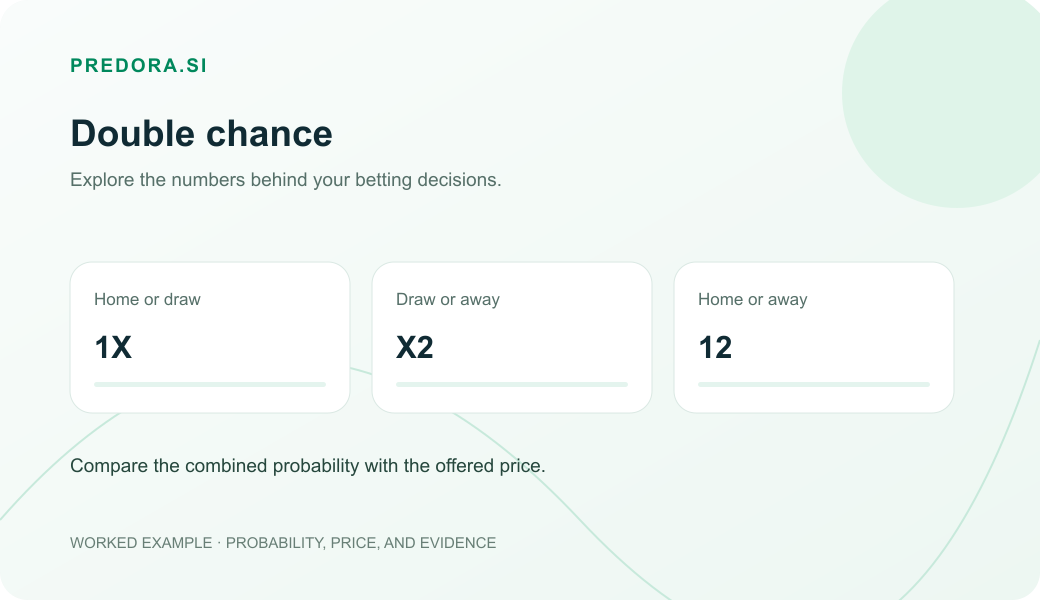
| Common options | 1X = home team wins or draws; X2 = draw or away team wins; 12 = home or away team wins. |
| Analyzed scenario | A more reliable side, with the draw still representing a real risk. |
| Core logic | You trade part of the return for more protection against a specific outcome. |
| Useful formula | EV = (estimated probability × odds) − 1 |
| Common mistake | Comparing Double Chance prices without checking the covered outcomes. |
| How Predora.si helps | Shows probability, EV, best odds, and match factors in the selected market. |
What is Double Chance?
Double Chance is a football market that allows you to cover two of the three possible outcomes of the match.
In the traditional 1X2 market, you choose only one outcome:
- 1: home win.
- X: draw.
- 2: away win.
In Double Chance, you combine two of these outcomes:
- 1X: home team wins or draws.
- X2: away team wins or draws.
- 12: home win or away win, and you lose if it's a draw.
In plain terms: Double Chance is buying protection.
You are not trying to call exactly who wins. You are saying that one side has enough strength to at least not lose, or that the match is unlikely to end in a draw.
It reduces one type of risk, but does not eliminate the risk of the bet. 1X loses if the away team wins, X2 loses if the home team wins, and 12 loses if the match ends in a draw.
What do 1X, X2, and 12 mean?
1X: home team wins or draws
The data tends to be more compatible with 1X when the home side looks more reliable, but the draw is still very much alive in the match.
- Strong home team at home.
- Competitive away team, but inconsistent on the road.
- Home team with a solid defense.
- A straight 1 looks risky or has squeezed odds.
X2: away team wins or draws
The data tends to be more compatible with X2 when the away team has enough strength to make things difficult, even away from home.
- Away team has a good away record.
- Home team fluctuates a lot.
- Away team is more consistent defensively.
- The draw seems like a plausible result.
12: either team wins
12 covers a win from either side and loses if the game ends in a draw. It usually makes more sense when the draw seems less likely.
The correct reading
The question is not whether Double Chance has a high chance of hitting. The question is whether the odds are paying well for the real probability of that protection.
How do protection, price, and context relate?
Double Chance tends to make more sense when there is a combination of protection, acceptable price, and coherent factors.
1. When there is favoritism, but the draw is a concern
This is the classic case. The model may point to a stronger side, but the factors show the game is not clean for a straight 1X2.
2. When the 1X2 is expensive or squeezed
Sometimes the favorite is clear, but the straight odds have already dropped too much. Double Chance only helps if the price of the protection has not become expensive.
3. When the factors point to solidity, not dominance
Double Chance suits teams that are hard to beat, even when a straight win is not strong enough.
4. When the protection increases, but the EV remains relevant
A selection can have a 75% chance and still be bad if the fair odds would be 1.33 and the market is paying 1.22.
5. When the game is tough, but there is a more reliable side
In balanced matches, the data can be more compatible with 1X or X2 when the odds are above the estimated fair price.
Which factors matter most?
Double Chance is a result-family market, so the central question is: is there enough strength to protect one side with draw coverage?
| Factor | Why it matters |
|---|---|
| Home vs away | Helps compare the home team at home with the away team on the road, without relying only on the overall table. |
| PPG | Points per game help measure competitive consistency in the right sample. |
| Consistency | Double Chance favors teams that fluctuate less and rarely fall apart. |
| Defensive strength | If the idea is not to lose, conceding few goals and giving up little space carries significant weight. |
| Recent form | Helps understand the current form and can converge with the broader sample or diverge from it. |
| Goal difference | Shows whether the team tends to impose itself or suffer more than it delivers. |
How to calculate whether Double Chance has value?
The logic is the same as any market: compare estimated probability with offered odds.
EV = (estimated probability × odds) − 1Fair odds = 1 ÷ estimated probabilityImplied probability = 1 ÷ oddsExample in football
Imagine a Brasileirão match where the model estimates:
- Home win: 47%.
- Draw: 29%.
- Away win: 24%.
1X = home win + draw 1X = 47% + 29% 1X = 76% Fair odds = 1 ÷ 0.76 Fair odds = 1.32If the best available odds for 1X are 1.38, the EV turns positive:
EV = (0.76 × 1.38) − 1 EV = 1.0488 − 1 EV = +4.88%But if the best odds are 1.24, the same chance becomes a negative EV reading based on price:
EV = (0.76 × 1.24) − 1 EV = 0.9424 − 1 EV = -5.76%High probability does not save bad odds.
Double Chance vs 1X2: what is the practical difference?
| Market | What needs to happen | Protection | Contextual reading |
|---|---|---|---|
| 1 straight | Home team must win. | Nothing against a draw. | Clear dominance and odds consistent with the probability. |
| 2 straight | Away team must win. | Nothing against a draw. | Away team underpriced relative to the estimate. |
| 1X | Home team wins or draws. | Protects against a home team defeat. | Reliable home team with relevant draw risk. |
| X2 | Away team wins or draws. | Protects against an away team defeat. | Competitive away team and inconsistent home team. |
| 12 | Either team wins. | Eliminates the draw; does not protect against it. | Relatively lower draw probability. |
The main difference is simple: 1X2 tries to hit one result. Double Chance tries to protect a read.
Which signs weaken the Double Chance reading?
When the odds are too low
If the odds do not compensate for the estimated probability, the read loses value. Low odds can hurt long-term returns.
When the factors are highly conflicting
Double Chance does not fix a bad read. It only changes the type of risk.
When the league sample is small
If the historical sample for that market or league is still short, the numbers can fluctuate significantly.
When 12 ignores a very live draw
If both teams create few chances and the match looks balanced, compare the draw probability carefully when evaluating 12.
How to interpret Double Chance in the long run
Double Chance usually has a higher hit rate than straight 1X2, but that does not mean a better return. The odds are lower, and hitting often is not enough when the price is poor.
8 hits in 10 bets with average odds of 1.20 8 × 0.20 = +1.6 units 2 misses = -2 units Final result = -0.4 unitsIn the long run, what matters is the combination of probability, odds, EV, and sample consistency.
How to apply Double Chance on Predora.si
On Predora.si, the read starts by identifying the displayed market. When the view changes to Double Chance, the probability, EV, selection, odds comparison, and factors must be read within that market.
| Step | How to use |
|---|---|
| 1. Select the market view | Use the market filter to look at the match through the Double Chance lens. |
| 2. Check the Active Model | The probability can change depending on the model, and the EV changes along with it. |
| 3. Compare probability and EV | Probability shows the estimated chance; EV shows whether the odds are paying well. |
| 4. Compare the factors | Read home/away, PPG, consistency, defense, recent form, and goal difference. |
| 5. Compare odds between bookmakers | When the read already makes sense, improving the price improves the expected outcome. |
| 6. Reassess consistency | If the odds have become squeezed or the factors conflict with each other, reassess EV, price, and context. |
On Predora.si, you can compare games in the selected market, see probability, EV, best odds, and factors to interpret whether the protection is consistent with the price.
Common mistakes in Double Chance
1. Ignoring the outcome your bet leaves uncovered
It covers two outcomes, but it still loses if the outcome outside the coverage happens.
2. Looking only at the probability
High probability with bad odds can have negative EV.
3. Using 1X whenever the home team is the favorite
Not every home favorite has a good 1X. The price may already be crushed.
4. Ignore home vs away
Comparing overall numbers can hide important risks.
5. Using X2 just because the odds are higher
Higher odds do not automatically mean value. You need probability supporting the price.
6. Using 12 in a game that looks like a draw
If the factors show balance and little creation, 12 can be dangerous.
Double Chance analytical checklist
- Is the selected market really Double Chance?
- How does each option relate to the scenario: 1X, X2 or 12?
- How does the estimated probability compare to the implied probability?
- Do the odds still offer fair value or positive EV?
- Home/away factors converge with the read or diverge from it?
- Does the protected team show consistency?
- Does the defensive strength support the idea of not losing?
- Recent form converges with the forecast or diverge from it?
- Is the league/market sample sufficient to give weight to the read?
- What is the best available odds for the same selection and line?
- If the odds have worsened, how does that change EV and relative price?
- If the factors are conflicting, what is the impact on the consistency of the read?
Practical example: comparison between 1X and straight 1
Imagine a Série A game with this scenario:
- Strong home team at home.
- Competitive away team, but inconsistent on the road.
- The home team concedes few goals.
- The draw appears as a real risk.
- The odds for a straight home win (1) are low.
- 1X still has slightly positive EV.
In this case, a straight home win (1) may be too aggressive for the scenario. The game is not necessarily saying "home team wins". It is saying something closer to: the home team has a good chance of not losing.
FAQ about Double Chance
How do I assess a Double Chance bet?
Compare the combined probability of the two covered outcomes with the offered odds. Also identify the uncovered outcome: away win for 1X, home win for X2, and draw for 12.
How do a straight home win (1) and 1X differ?
A straight home win (1) covers only a home victory and usually has higher odds. 1X covers a home win or a draw and usually has lower odds. Probability, odds, and factors allow you to compare the scenarios.
What scenario does X2 represent?
X2 combines an away win and a draw. Away consistency, defense, home team form, and draw probability are signals that contextualize this scenario, without determining an action.
How does a low odd affect the EV of Double Chance?
The lower the odds, the higher the probability required for the break-even point. The comparison with the estimated probability determines whether the calculated EV is positive or negative.
Is the 12 market Double Chance?
Yes. 12 covers a home win or an away win. It loses on a draw. Its probability corresponds to the estimated sum of the home team's and away team's chances of winning.
Closing
Double Chance covers two outcomes, but that does not imply positive EV. Probability, odds, EV, factors, and context remain separate dimensions of the comparison.
Predora.si organizes odds as prices, models as estimates, and factors as context for independent comparison.