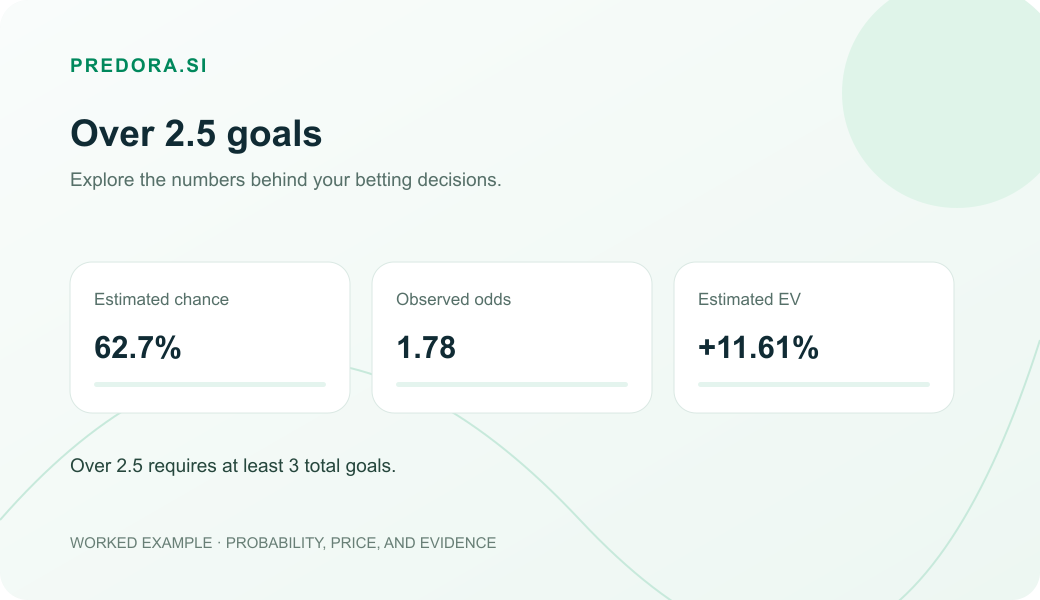
Direct answer
Over 2.5 goals is the market in which the bet wins if the match has 3 or more goals in regular time. To analyze it well, it is not enough to look for "attacking teams": you need to compare estimated probability, offered odds, EV, goal average, goals scored and conceded, shots on target, xG, home/away context, and league pattern.
In plain Portuguese: it is not about rooting for a goal fest. It is about understanding whether the match really has the look of goals and whether the odd is paying a price that makes sense.
Quick summary
| Point | How to interpret |
|---|---|
| Definition | Over 2.5 goals means the bet wins if 3 or more goals are scored in the match. |
| Line | The line is 2.5 goals. Because there is a half goal, there is no draw in the bet. |
| When it makes sense | When offensive production, defensive fragility, pace, and probability point to an open game. |
| Main formula | EV = (estimated probability × odds) − 1 |
| Common mistake | Thinking that two good teams automatically mean Over 2.5. Sometimes they lock the game down. |
| How Predora.si helps | It shows probability, EV, best odds, and factors for the goals market to contextualize the reading with method. |
What does Over 2.5 goals mean?
In the Over/Under market, you are betting on the total goals of the game, not on who wins. In the case of Over 2.5, the central question is:
Does this game have a good chance of ending with 3 or more goals?
The bet wins on scorelines like 2-1, 3-0, 2-2, or 4-1. It loses on 0-0, 1-0, 1-1, or 2-0.
| Score | Does Over 2.5 hit? |
|---|---|
| 2x1 | Yes |
| 3x0 | Yes |
| 2x2 | Yes |
| 1x1 | No |
| 2x0 | No |
| 0x0 | No |
The important detail is that Over 2.5 does not depend on both teams scoring. A 3-0 hits Over 2.5, but does not hit Both Teams to Score. Meanwhile, a 1-1 hits Both Teams to Score, but does not hit Over 2.5.
Over 2.5, Under 2.5, and BTTS: what is the difference?
| Market | Central question | Example that hits |
|---|---|---|
| Over 2.5 goals | Will the game have 3 or more goals? | 2-1, 3-0, 2-2 |
| Under 2.5 goals | Will the game have up to 2 goals? | 0-0, 1-0, 1-1, 2-0 |
| BTTS / Both teams to score | Will both teams score? | 1-1, 2-1, 1-2 |
Over 2.5 looks at the total volume of goals. BTTS looks at the offensive participation of both sides. They talk to each other, but they answer different questions.
How to calculate whether the Over 2.5 odds are good?
To know whether an Over 2.5 odd is good, compare the estimated probability of Over hitting with the offered odds by the bookmaker.
Implied probability = 1 ÷ decimal oddsFair odds = 1 ÷ estimated probabilityEV = (estimated probability × odds) − 1Edge = estimated probability − implied probabilityQuick example
Imagine the model estimates 54% chance for Over 2.5 goals in a Brasileirão game. The best available odd is at 2.05.
Implied probability = 1 ÷ 2.05 Implied probability = 0.4878 Implied probability = 48.8%Fair odds = 1 ÷ 0.54 Fair odds = 1.85EV = (0.54 × 2.05) − 1 EV = 1.107 − 1 EV = +10.7%Under this probability estimate, the price exceeds fair value. Explore the match factors and model history to assess the estimate.
Which factors matter most for analyzing Over 2.5?
A single statistic rarely tells the whole story. The analysis gets better when you combine layers.
1. Goal potential of the game
A game projected near 3 goals tends to align better with Over 2.5 than a game projected for 2.1 or 2.2 goals. Average is not destiny, but it is a good starting point.
2. Goals scored per game
Check whether the home team usually scores at home, whether the away team scores away, and whether recent production confirms the season.
3. Goals conceded per game
Over also depends on concession. Often the strong signal is an okay attack with a defense that concedes a lot.
4. Shots on target and offensive volume
Shots and shots on target help you see paths to goals, but empty volume is not the same as a clear chance.
5. xG and quality of chances
xG helps separate teams that shoot a lot without danger from teams that create genuinely better chances. For goals, quality matters.
6. Home, away, and league average
Compare home team at home, away team away, and the competition's pattern. Brasileirão, Série B, Libertadores, and cups can have very different paces.
7. Recent form
Recent games help capture form, injuries, and changes in approach, but the sample is short. Use it as confirmation.
8. H2H as a complement
Head-to-head can help, but it usually has a small sample and outdated contexts. Use it as support, not as the main basis.
What is a good scenario for Over 2.5?
An interesting scenario usually appears when probability, price, and factors move together.
| Signal | Why it matters |
|---|---|
| High expected goal average | Indicates a more open pre-game reading. |
| Over 2.5 strong potential | Shows that the 2.5 line is consistent with the projection. |
| Two productive attacks | Increases paths to goals. |
| Defenses that concede | Reduces dependence on a perfect attack. |
| Consistent shots on target | Shows real danger, not just empty possession. |
| Odd above fair odds | Turns a good reading into a possible value bet. |
A strong Over 2.5 is not born from a single nice number. It is born when probability, price, and context confirm each other.
Practical example in football
Imagine a game between Team A and Team B in the Brasileirão. The pre-game scenario shows:
| Factor | Team A at home | Team B away |
|---|---|---|
| Goals scored / game | 1.8 | 1.2 |
| Goals conceded / game | 1.1 | 1.5 |
| Shots on target / game | 5.4 | 4.1 |
| Last 5 games with 3+ goals | 3/5 | 4/5 |
Now imagine the Active Model estimates 54% chance for Over 2.5, with the best available odd at 2.05.
| Metric | Calculation | Outcome |
|---|---|---|
| Implied probability | 1 ÷ 2.05 | 48,8% |
| Fair odds | 1 ÷ 0.54 | 1.85 |
| Edge | 54% − 48,8% | +5.2 p.p. |
| EV | (0.54 × 2.05) − 1 | +10,7% |
In this scenario, the factors point to a goals profile and the odd is above the estimated fair price. The comparison also includes lineup, knockout stage, weather, pitch, offensive absences, and other contexts that could change the expected pace.
How to interpret Over 2.5 in the long run
Over 2.5 is a market with quite a bit of variance. Even a good reading can lose due to a goalkeeper having a great day, clear chances wasted, hitting the woodwork, a missed penalty, or a team that goes 1-0 up and drops deep.
The right question is not "will this Over hit?". The more useful question is:
Is the estimated probability higher than the implied probability of the odd, and do the game factors support that reading?
In the long run, the focus should be on repeating good assessments, comparing odds, and evaluating return, variance, and consistency across a base of games.
How to analyze Over 2.5 on Predora.si
On Predora.si, the Over 2.5 goals market is analyzed as its own lens. Probability, EV, best odd, and factors need to be read within the selected market.
| Step | How to use |
|---|---|
| 1. Open Upcoming Games | Select the Over 2.5 goals market to see games, probability, EV, and the best available odd. |
| 2. Filter by league | Goals markets change between competitions. League, Base, Hit Rate, and Return contextualize the comparison. |
| 3. Compare probability and EV | High probability without a good odd may have no value. A good odd without coherent factors can be noise. |
| 4. See the odds comparison | The same bet can pay differently at different bookmakers. Improving price improves EV. |
| 5. Compare AI + Statistics | Look for goal potential, potential Over 2.5, goals scored and conceded, xG, shots on target, league average, and H2H. |
| 6. Use Upcoming Games with EV+ | The Over 2.5 goals filter organizes scenarios in which the model estimates positive EV. |
Use the game grid, odds comparison, and per-market factors to assess whether the price and the scenario are speaking the same language.
When can Over 2.5 be a trap?
1. High average driven by a few games
A 5-0 or 4-2 can inflate the average. Look at distribution, not just the final number.
2. Attacking team against a reactive opponent
A team may attack a lot, but face a rival that drops deep, plays at a low tempo, and accepts a low-scoring result.
3. Two good teams, a game with a lot of respect
Derbies, knockout ties, and direct clashes can become more conservative even with good attacks.
4. Strong Over, but bad odd
High probability is not the same as value. If the odd is crushed, the price may not be worth it.
5. Last 5 games misleading
Recent form helps, but it can be noisy. It needs to align with season, home/away, and offensive production.
Common mistakes when analyzing Over 2.5
Thinking Over 2.5 and BTTS are the same
A 3-0 result hits Over and misses BTTS. A 1-1 result hits BTTS and misses Over.
Looking only at goals scored
Over also depends on goals conceded, pace, and defensive fragility.
Ignore home/away
Home team at home and away team away is the cut closest to the real game.
Confusing high odds with value
Value appears when the odd is above the fair odd estimated by probability.
Blindly trusting H2H
Head-to-head can help, but it normally should not be the basis of the decision.
Ignoring variance
An Over can lose even with good signals. The focus needs to be on process and price.
Practical checklist for analyzing Over 2.5
- Confirm the line: is it really Over 2.5?
- See the estimated probability: does the Active Model point to an interesting probability?
- Compare with the odds: are the odds above the fair odds?
- Calculate the EV: is there positive expected value?
- Look at goals scored and conceded: do both sides support a goals scenario?
- Check home/away: do home team at home and away team away confirm it?
- Use shots on target and xG: is there real danger or just empty volume?
- Compare with the league average: is the game above the standard?
- Compare recent games: does the momentum confirm or contradict it?
- Treat H2H as a complement: do not base everything on it.
- Look for signs against: knockout stage, missing players, reactive style, or table context.
- Relate price and context: favorable signals without a coherent odd can result in weak or negative EV.
FAQ about Over 2.5 goals
What is Over 2.5 goals?
Over 2.5 goals is a bet on the total goals of the match. It wins if the game has 3 or more goals and loses if it ends with 0, 1, or 2 goals.
Is Over 2.5 the same as Both Teams to Score?
No. Over 2.5 looks only at the total goals. Both Teams to Score requires both teams to score. A 3-0 game hits Over 2.5, but does not hit Both Teams to Score.
What do low odds on Over 2.5 tell me?
Low odds imply a higher probability in the price. Compare that percentage with the model’s estimate and attacking and defensive factors to assess value.
Which statistics should I look at for Over 2.5?
The main ones are expected goal average, goals scored, goals conceded, xG, shots on target, home/away, recent games, league average, and Over 2.5 history.
How do I know if Over 2.5 has value?
Compare the estimated probability with the available odd. If the offered odd is above the fair odd calculated from the probability, value may exist. The EV formula helps with this reading.
How do I evaluate positive EV on Over 2.5?
Compare the offered odds with the estimated probability, then explore attacking output, defensive records, and current match context.
Conclusion
Over 2.5 goals is not about hoping for an open game. It is about analyzing whether the match has real signs of 3 or more goals and, above all, whether the odd pays well for the estimated probability.
Predora.si helps in this process by bringing together Active Model probability, best available odd, EV, and per-market statistics so you can move past guesswork and analyze Over 2.5 with more clarity.