Direct answer
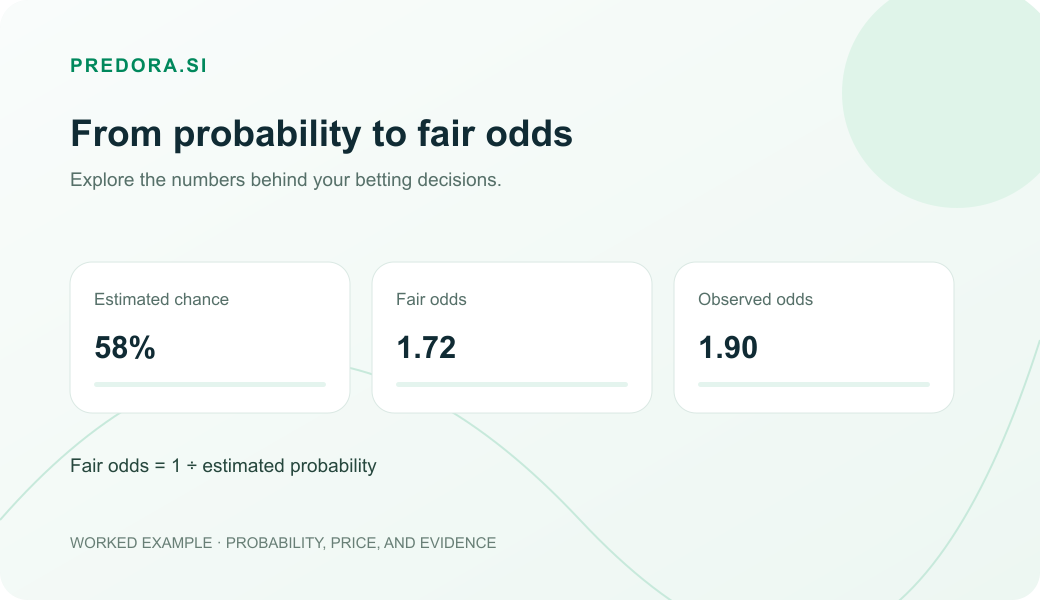
Fair odds is the price consistent with an estimated probability. To know whether the odds are paying well, compare the odds offered by the bookmaker with the fair odds from your model. If the bookmaker pays above the fair odds, value may exist; if it pays below, the odds are probably poor for that probability.
Quick summary
| Definition | Fair odds is the price that is mathematically consistent with an estimated probability. |
|---|---|
| Formula | Fair odds = 1 ÷ estimated probability |
| When are the odds paying well? | When the bookmaker's odds are higher than the fair odds calculated by the model. |
| Value signal | Bookmaker odds above fair odds, positive edge, and positive EV. |
| Common mistake | Thinking that high odds are automatically good. Odds are only good when they pay more than the estimated chance justifies. |
| How Predora.si helps | Shows Active Model probability, fair odds, best available odds, edge, and EV per market. |
Fair odds translate an estimated probability into a break-even price. Compare that reference with bookmaker odds to investigate potential value.
What are fair odds?
Fair odds, also called correct odds or fair odds, is the price an outcome should have if the odds were based only on the estimated probability, without bookmaker margin and without fat in the price.
In plain Portuguese:
- if you estimate that an outcome has 50% chance, the fair odds are 2.00;
- is estimated 60%, the fair odds are 1.67;
- is estimated 40%, the fair odds are 2.50.
The higher the estimated chance, the lower the fair odds. The lower the estimated chance, the higher the fair odds.
The important point is that fair odds do not say "this will happen." They say: "for this probability, this would be a mathematically fair price."
Fair odds formula
The probability must be in decimal, not percentage.
Fair odds = 1 ÷ estimated probabilityImplied probability = 1 ÷ decimal oddsQuick table
| Estimated probability | Calculation | Fair odds |
|---|---|---|
| 70% | 1 ÷ 0.70 | 1,43 |
| 60% | 1 ÷ 0.60 | 1,67 |
| 55% | 1 ÷ 0.55 | 1,82 |
| 50% | 1 ÷ 0.50 | 2,00 |
| 40% | 1 ÷ 0.40 | 2,50 |
| 33,3% | 1 ÷ 0.333 | 3,00 |
| 25% | 1 ÷ 0.25 | 4,00 |
How to know if the odds are paying well?
The practical rule is this:
If bookmaker odds > fair odds, the odds may be paying well. If bookmaker odds = fair odds, the price is close to neutral. If bookmaker odds < fair odds, the odds are paying too little for that chance.| Model probability | Fair odds | Bookmaker odd | Reading |
|---|---|---|---|
| 55% | 1,82 | 2,05 | The bookmaker pays above fair: there may be value. |
| 55% | 1,82 | 1,82 | Fair or neutral price. |
| 55% | 1,82 | 1,70 | The bookmaker pays below fair: poor price. |
So when someone asks "are these odds good?", the right question is: good relative to which probability? Without an estimated probability, the odds are just a loose number.
Football example: 1x2 market
Imagine a Brasileirão game in the market 1x2, where you are analyzing the home team's win.
Home team's chance of winning = 55% Fair odds = 1 ÷ 0.55 = 1.82 Best bookmaker odds = 2.05| Chance estimated by the model | 55% |
|---|---|
| Fair odds | 1,82 |
| Best bookmaker odds | 2,05 |
| Bookmaker's implied probability | 48,8% |
| Approximate edge | +6.2 p.p. |
| Approximate EV | +12,75% |
In this case, the bookmaker is paying 2,05 for something the model understands should pay close to 1,82. In theory, this indicates that the odds are above the fair price.
Under the model’s probability estimate, these odds exceed fair value. Compare the team factors and model history to investigate the price.
How to calculate the implied probability of the odds
Implied probability is the chance that the bookmaker's odds are embedding in the price.
Implied probability = 1 ÷ decimal odds Odds 2.05 1 ÷ 2.05 = 0.488 Implied probability ≈ 48.8%If the model estimates 55% and the bookmaker prices it as if it were 48,8%, there is a difference in favor of the observer. That difference is the edge, or estimated difference.
Fair odds, bookmaker odds, implied probability, and EV
| Concept | What it means | Formula | How to use |
|---|---|---|---|
| Fair odds | Fair price according to the estimated probability. | 1 ÷ probability | Serves as a reference to compare with the bookmaker. |
| Bookmaker odd | Price offered by the bookmaker. | No need to calculate. | It is the real price available in the market. |
| Implied probability | Chance embedded in the bookmaker's odd. | 1 ÷ odd | Shows how the bookmaker is pricing the outcome. |
| Edge | Difference between the model's chance and the bookmaker's implied chance. | model probability − implied probability | Shows whether the model sees an advantage over the price. |
| EV | Expected value of the bet. | (probability × odd) − 1 | Shows whether the mathematical expectation is positive or negative. |
High odds are not the same as odds paying well
This is one of the most common mistakes.
Odds of 4.00 may look nice, but if the outcome has only 15% chance, the fair odds would be:
Fair odd = 1 ÷ 0.15 = 6.67In this case, odds of 4.00 are not high. They are too low for the risk.
Now, odds of 1.85 may look boring, but if the model estimates 60% chance, the fair odds would be:
Fair odd = 1 ÷ 0.60 = 1.67Then odds of 1.85 are paying above fair. Moral of the story: good odds are not high odds. Good odds are odds above the fair price.
Opposite example: high probability, but poor odds
Now imagine a strong favorite in a Série B game.
Favorite's chance of winning = 70% Fair odds = 1 ÷ 0.70 = 1.43 Bookmaker odds = 1.35 EV = (0.70 × 1.35) − 1 EV = 0.945 − 1 EV = -0.055 EV = -5.5%Even with 70% chance, the odds are paying too little. This is the type of scenario where the selection may even be likely, but it does not necessarily have value.
That is why two screens can answer different questions:
- Upcoming Games with High Probability: which one has the higher chance?
- Upcoming Games with EV+: what is paying above fair?
The best scenario is when chance and price align well.
When does an odd signal a price above fair value?
This divergence appears when three points combine:
- The estimated probability is higher than the bookmaker's implied probability.
- The bookmaker's odd is above the fair odd.
- The EV is positive after comparing chance and odd.
Model probability > bookmaker's implied probability Bookmaker's odd > fair odd EV > 0When these three signals appear together, the odd may be paying well. But you still need to contextualize the game scenario: lineup, schedule, team style, pitch, sample, form, and tactical variation. Even with value, the bet still carries risk.
How to interpret fair odds in the long run
Fair odds are a process tool, not a crystal ball.
A bet with odds above fair value can lose. If the model estimates 55%, there is still 45% chance of not hitting. The goal is not to win every time. The goal is to repeat analyses where the observed price is above the estimated fair value.
| Situation | Correct reading |
|---|---|
| An EV+ bet lost | Normal. A single bet does not prove the read was wrong. |
| Multiple EV+ bets with a solid foundation generate positive returns | A sign that the process may be working. |
| Odd above fair value, but game factors are conflicting | Explore why the match context differs from the model’s estimate before assessing the price. |
| Model with a small sample | More volatile metric; it cannot be treated as absolute truth. |
| Odd changed after the analysis | Recalculate. EV depends on the odd available now. |
How to apply fair odds on Predora.si
On Predora.si, the fair odds read appears within the logic of the Active Model. This model calculates the probability for the selected market, and from that chance the app shows the fair odds, the EV, and the comparison with bookmaker odds.
1. Identify the game and the market
Upcoming Games and Upcoming Games with EV+ organize events and markets for analysis.
2. Select the market
Always compare the same market and the same line: 1x2, Double Chance, Over, BTTS, or corners.
3. Check the Active Model
The probability used in the calculation depends on the model selected for the analysis.
4. Compare price and chance
See estimated chance, fair odd, best available odd, edge, and EV.
5. Compare the context
Odds Comparison and AI + Stats add price references and context to the read.
In practice, Predora.si helps turn the question "does this odd look good?" into a better question:
Is this odd paying above what my model considers fair for this market?
Where to look inside Predora.si
| Predora.si area | How it helps with fair odds reading |
|---|---|
| Active Model | Defines the probability used to calculate fair odds, EV, and estimated difference. |
| Match highlights | Shows fair odds, bookmaker probability, edge, and EV in a quick format. |
| Odds Comparison | Helps find which bookmaker is paying the most for the same market. |
| Upcoming Games with EV+ | Lists scenarios with positive EV according to the Active Model. |
| Upcoming Matches | Lets you explore all games and compare chance, EV, market, and league. |
| AI + Statistics | Helps assess whether game factors support the mathematical read. |
| Performance | Compares the Active Model across leagues using Sample, Accuracy, and Return. |
How to use fair odds by market
The formula is the same, but the interpretation changes by market.
| Market | Main question | How to use fair odds |
|---|---|---|
| 1x2 | Who wins or draws? | Compare the fair odd for home, draw, or away with the bookmaker's best odd. |
| Double Chance | Does one side avoid defeat? | See if the odd pays well even with greater protection. |
| Over 2.5 goals | Does the game look like 3 or more goals? | Compare the estimated over chance with the odd offered for that line. |
| Both Teams to Score | Do both teams have a path to score? | See if the price compensates for the BTTS probability. |
| Over 9.5 corners | Does the game have volume for many corners? | Compare the estimated over corners chance with the market odd. |
Attention: always compare the same market and the same line. An Over 2.5 odds should not be compared with a Both teams to score odds, because they are different questions.
Fair odd and bookmaker margin
The fair odd is a clean reference, calculated from the estimated probability. The bookmaker's odd, on the other hand, usually includes the bookmaker margin.
That is why, in markets like 1x2, if you convert all odds into implied probability and add them up, the total usually exceeds 100%.
| Outcome | Bookmaker odd | Implied probability |
|---|---|---|
| Home | 2,00 | 50,0% |
| Draw | 3,40 | 29,4% |
| Away | 3,80 | 26,3% |
| Total | 1x2 market | 105,7% |
That extra above 100% is part of the margin. That is why comparing odds between bookmakers matters a lot: sometimes the same bet is just okay at one bookmaker and interesting at another.
Common mistakes when analyzing fair odds
1. Thinking a high odd is always value
A high odd is only value if it is above the fair odd. A 5.00 odd can be bad if the event should pay 8.00.
2. Thinking high probability is enough
A favorite with a 75% chance can be a bad bet if the bookmaker pays as if it had 85%.
3. Using implied probability as real chance
Implied probability shows what the bookmaker is pricing, not necessarily the real chance of the event.
4. Compare different markets
You cannot directly compare a 1x2 odd with an Over 2.5 odd. Each market answers a different question.
5. Ignoring that the odd changes
If the odd drops, the EV can disappear. A good entry at 2.05 may no longer make sense at 1.78.
6. Forgetting to contextualize the scenario
An odd above fair value is an important signal, but lineup, form, team style, league, factors, and sample also factor into the decision.
7. Skipping the probability behind fair odds
Fair odds are a price reference derived from your probability estimate. Comparing the model’s history helps you assess that reference.
Checklist for interpreting fair odds
- Identify the market being analyzed. E.g.: 1x2, Double Chance, Over 2.5, BTTS, or corners.
- Look at the estimated probability. It can come from your own model or from Predora.si's Active Model.
- Calculate the fair odd. Use
1 ÷ probability. - Compare with the best available odds.
- Check the bookmaker's implied probability. Use
1 ÷ bookmaker's odd. - Calculate the edge. Model probability minus implied probability.
- Calculate the EV. Use
(probability × odd) − 1. - Interpret it alongside the factors. Context, league, market, recent form, and sample affect the estimate.
- Consider the time of the quote. Odds change, and the comparison represents the price observed at that moment.
- Understand the outcome. Odds above fair value indicate positive EV under the probability estimate used.
Essential formulas
Fair odds = 1 ÷ estimated probabilityImplied probability = 1 ÷ decimal oddsEdge = model probability − implied probability of the oddsEV = (estimated probability × odds) − 1On Predora.si, you compare the Active Model probability with the best available odd and see where positive EV may exist in football games.
FAQ about fair odds
Are fair odds and correct odds the same thing?
Yes. In the betting context, fair odds, correct odds and fair odds usually mean the same thing: the price consistent with an estimated probability.
Does the bookmaker's odd need to be higher or lower than the fair odd?
For value to exist for the bettor, the bookmaker's odd needs to be greater than the fair odd. That means the bookmaker is paying more than the estimated probability suggests.
Does an odd above fair value already define a bet?
Odds above fair value indicate positive EV under your estimate. Review the market, match factors, league, and model history to assess the opportunity.
Do fair odds work for any market?
Yes. The same calculation applies to 1x2, Double Chance, goals, BTTS, and corners when you have a probability estimate for that market. Compare identical markets and lines.
Why do fair odds change when I switch models?
Because fair odds depend on the estimated probability. If the Active Model changes, the probability can change; if the probability changes, the fair odds change too.
Is positive EV the same thing as fair odds?
No. The fair odd is the reference price. EV measures the mathematical expectation of the bet using the estimated probability and the offered odd. Normally, when the bookmaker's odd is above the fair odd, the EV tends to be positive.
Closing
Fair odds give you a clear price reference. Use them to see how bookmaker odds compare with your view of the match.
In football, where variance is high and a single play changes everything, the most important thing is to evaluate these metrics on larger samples. Predora.si crosses the Active Model probability, best available odd, EV, and statistical factors to offer a comparable read.