Direct answer
Stake is the amount exposed in a specific bet. In football betting, it works as a risk unit: if the bet loses, you lose the stake; if it wins, the return is calculated by the stake multiplied by the odds.
Definition in one sentence: stake is the amount associated with the exposure of a bet in a record or simulated scenario.
Quick summary
| What is | Amount placed on a specific bet. |
|---|---|
| What it's for | Measure exposure, compare records, and understand the impact on risk. |
| Simple formula | Stake in $ = bankroll × defined percentage |
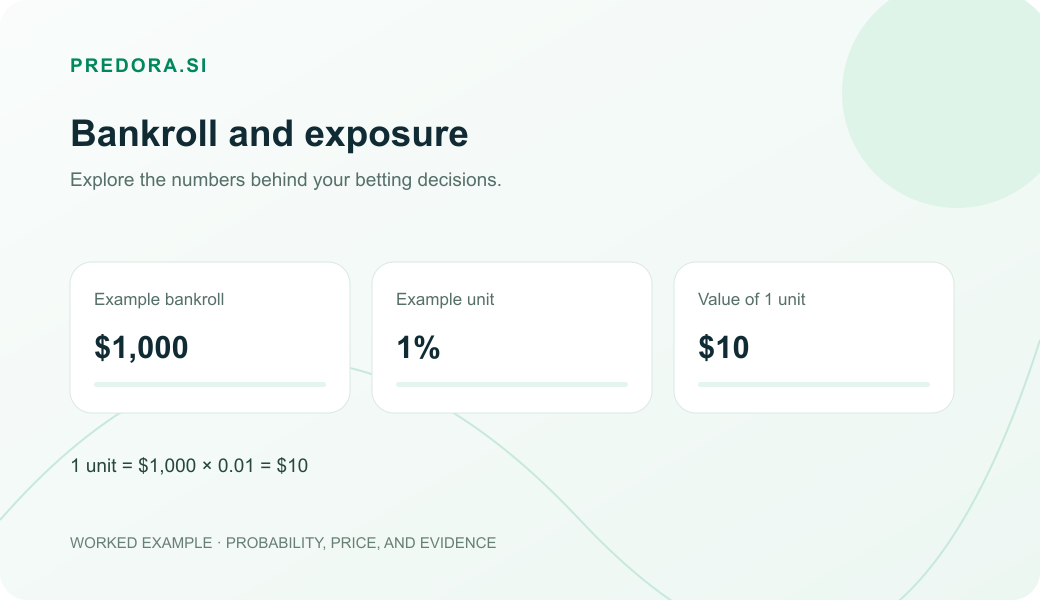
| Example | Bankroll of $1,000 with a 1% stake = $10 per bet. |
| Common mistake | Interpreting a larger stake as a higher probability of winning. |
| How Predora.si helps | It shows chance, EV, best odds, and context; the stake serves as an exposure reference in historical analysis. |
This entry discusses stake as the amount wagered and a risk unit, not a review of a bookmaker called Stake.
How stake affects risk and exposure
Think of stake as the size of the recorded exposure.
Probability, odds, and EV describe the price and the expectation; stake describes how much an individual outcome weighs on the bankroll used as a reference.
In quantitative analyses, consistent stake rules allow comparing exposure, return, and variance without confusing position size with estimate quality.
Fixed stake
All records use the same value, for example $10.
Percentage stake
The value is expressed as a percentage of the reference bankroll, such as 1%.
Stake in units
Records are measured as 0.5u, 1u, or 2u to allow comparison without depending on the amount in reais.
Useful formulas
Stake in $ = available bankroll × defined percentageTotal return = stake x decimal oddsPotential profit = (stake x decimal odds) - stakeStake in units = amount wagered / value of 1 unit| Stake in $ | Shows the amount exposed in that record. |
|---|---|
| Total return | Shows how much is returned if the bet wins, considering decimal odds. |
| Potential profit | Shows the net gain, already deducting the initial stake. |
| Stake in units | Helps compare bets even when people have different bankrolls. |
Example in football
Consider a hypothetical example with a reference bankroll of $1.000 and a standard stake of 1%.
Stake = $1,000 × 1% Stake = $10In a hypothetical Brasileirão game in the 1x2market, the observed odds for a selection are 2.20. With a stake of $10, the calculation becomes:
Total return = $10 × 2.20 Total return = $22 Potential profit = $22 - $10 Potential profit = $12If the result is negative, the loss on the record equals the stake: $10. The main point is simple: the stake defines the size of the risk, the odds define the potential return, and probability plus EV help assess whether the price makes sense.
Stake, unit, and bankroll: what is the difference?
| Term | What it means | Simple example |
|---|---|---|
| Bankroll | Money set aside for betting. | $1.000 |
| Stake | Amount risked on a specific bet. | $10 |
| Bet unit | Standardized way to measure stake. | 1u = $10 |
| Odds | Price paid by the bookmaker if the bet wins. | Odds 2.20 |
| Return | How much is returned if the bet wins. | $22 with a stake of $10 at odds of 2.20 |
An easy way to remember: bankroll is the total, stake is the entry amount, unit is the ruler, and odds is the price.
How to interpret stake in the long run
Stake does not change the outcome or the probability. In football, even a well-calibrated estimate can diverge from the result due to variance: own goal, penalty, red card, set piece, individual error, defensive block, VAR, and other scenarios outside the plan.
A larger stake relative to the bankroll increases the proportional effect of each result. Use this relationship to compare staking scenarios.
- Identify the bankroll used as a reference.
- Note which stake rule was applied to the records.
- Compare odds, probability, EV, and exposure.
- Check whether the criterion remained consistent in the sample.
- Interpret the result on a base, not by an isolated case.
How it appears on Predora.si
Predora.si does not define individual stakes and does not accept bets. The platform presents probability, price, and statistical context.
The platform organizes these dimensions for analysis:
- Chance of the selection in the selected market.
- EV of the bet.
- Best odds available among compared bookmakers.
- Active Model used in the reading.
- Upcoming Games with EV+, when the focus is positive EV.
- Upcoming Games with High Probability, when the focus is high probability.
- AI + Statistics, to interpret the context of the estimate.
Predora helps compare probability and price. The stake shows the effect of exposure on risk and outcome.
Common mistakes about stake
1. Confusing stake with odds
Stake is the amount wagered. Odds is the price paid by the bookmaker. Betting $10 at odds of 2.20 means a stake of $10 and a possible total return of $22.
2. Linking stake to a previous loss
A previous outcome does not change the probability formula of the next event. Increasing the stake only raises exposure.
3. Thinking a higher stake increases the chance of winning
It does not increase it. A larger stake only increases the size of the win or loss. It does not change the real probability of the game.
4. Comparing stakes under different criteria
Fixed, percentage, and unit stakes are distinct scales. Mixing them without normalization makes it harder to compare the sample.
5. Ignoring that decimal odds include the stake in the return
In decimal odds, the total return already includes the amount wagered. A stake of $10 at odds of 2.00 returns $20 in total if it wins.
Checklist for interpreting the impact of stake
- Identify the reference bankroll. It is the basis for the percentage calculation.
- Understand the unit used. Mathematical example: 1 unit = 1% of the bankroll.
- Check the consistency of the ruler. Frequent changes make it harder to compare results.
- Observe changes after losses. Reactive increases raise exposure and can distort the analysis.
- Compare results over a larger base. An isolated case does not allow evaluating management.
- Consider the percentage relationship. The same amount represents different exposures across different bankrolls.
Explore the bankroll management guide and the public tools to compare how odds, probability, EV, and stake affect the risk reading.
FAQ about stake
Is stake the same as a betting unit?
Not exactly. Stake is the amount placed on a bet. Bet unit is a way to standardize that amount. If 1u is worth $10, betting 2u means using a stake of $20.
What is the difference between stake and bankroll?
Bankroll is the total money set aside for betting. Stake is the portion of that bankroll used on a specific bet.
Does a larger stake mean a better bet?
No. A larger stake only increases the size of the risk. A bet only gets better when probability, odds, and expected value make sense.
Does subjective confidence change the stake calculation?
Variable stakes change the exposure of each record. Fixed and percentage stakes provide different ways to standardize that exposure.
Does Predora.si calculate an individual stake?
Use Predora’s bankroll and Kelly calculators to explore stake scenarios. Compare their inputs with the probability, odds, and match evidence shown in the analysis.
Next steps
Stake measures how much of your bankroll a bet uses. Compare stake sizes alongside probability, EV, and variance to explore their effect on results.