Direct answer
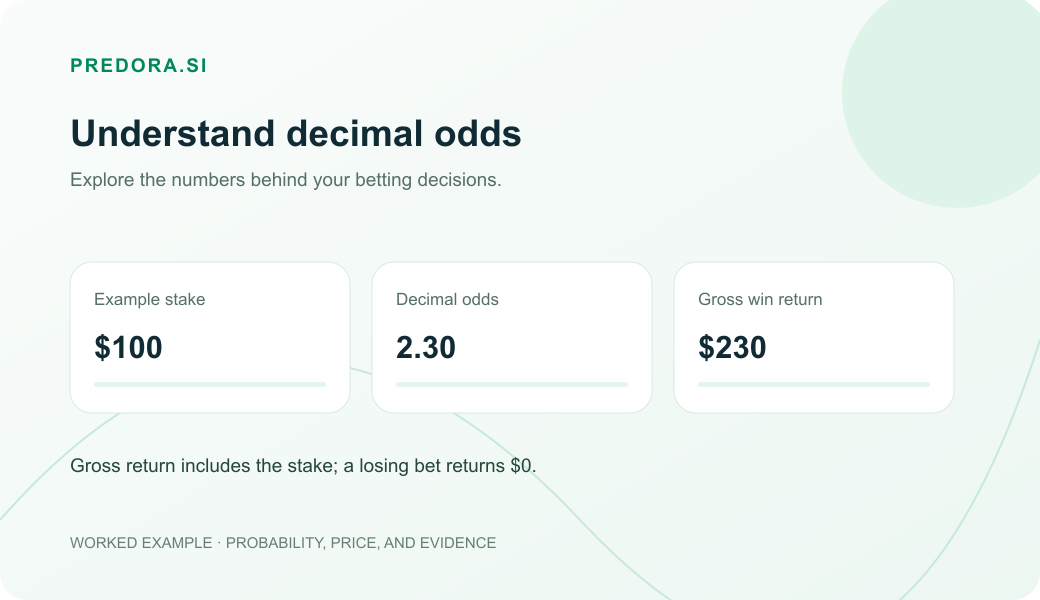
Decimal odds is the most common odds format in sports betting in Brazil. It shows how much comes back in total if the bet wins, already including the amount staked. For example, a decimal odds of 2.30 means total return of $230 for a stake of $100.
The essential reading is simple: decimal odds show total return, not net profit.
Quick summary
| Definition | Decimal odds are the price of the bet in numerical format, such as 1.85, 2.10, or 3.40. |
|---|---|
| What it shows | The total return of a winning bet, including the stake. |
| Return formula | Total return = amount staked × decimal odds |
| Profit formula | Potential profit = stake × (decimal odds − 1) |
| Implied probability | Implied probability = 1 ÷ decimal odds |
| Common mistake | Thinking that total return is net profit. |
| How Predora.si helps | Compares decimal odds across bookmakers and cross-references price with probability, fair odds, edge, and EV. |
Decimal odds is the quote that multiplies the stake to show the total return of a winning bet, including the original stake.
How do decimal odds work?
Decimal odds work as a multiplier. If you bet $1 on odds 2.00, the total return will be $2 if the bet wins. If you bet $100, the total return will be $200.
Decimal odds show the total amount returned, not just the profit.
| Decimal odds | Practical reading |
|---|---|
| 1.50 | Scenario that is generally more likely, with a lower return. |
| 2.00 | Doubles the stake in the total return. |
| 3.00 | Pays more, but usually represents a less likely scenario. |
A high odd does not automatically imply positive EV. A low odd also does not imply negative EV. What matters is comparing the odds price with the estimated probability of that outcome.
Decimal odds formulas
Total return = amount staked × decimal oddsPotential profit = stake × (decimal odds − 1)Implied probability = 1 ÷ decimal oddsImplied probability (%) = (1 ÷ decimal odd) × 100Simple example
Stake = $100 Decimal odds = 2.30 Total return = 100 × 2.30 = $230 Potential profit = 100 × (2.30 − 1) = $130Example in football
Imagine a Brasileirão game in the market 1x2, with the selection Home team wins decimal odds 2.30.
| Item | Value |
|---|---|
| Stake | $100 |
| Decimal odds | 2.30 |
| Total return if it hits | $230 |
| Potential profit | $130 |
The $230 are not profit. The profit is $130, because the $100 original stake comes back within the total return.
How to convert decimal odds into probability?
Decimal odds also allow you to calculate the implied probability, that is, the chance that price is suggesting.
Implied probability = 1 ÷ decimal odds Implied probability (%) = (1 ÷ decimal odds) × 100| Decimal odds | Approximate implied probability |
|---|---|
| 1.50 | 66,7% |
| 1.80 | 55,6% |
| 2.00 | 50,0% |
| 2.30 | 43,5% |
| 3.00 | 33,3% |
Odds of 2.30 prices the outcome close to 43,5% chance, before any margin and context adjustments. This calculation is the basis for comparing the bookmaker's odds with the probability estimated by a model.
Decimal odds, fair odds, and EV: where does value come from?
Decimal odds alone do not tell you whether a bet is good. They show the price. To know whether that price makes sense, you need to compare the offered odds with an estimated probability.
Example:
- the model estimates 50% chance for Over 2.5 goals;
- the fair odds for 50% would be 2.00;
- if a bookmaker offers odds 2.20, it is paying above the estimated fair odds.
Fair odds = 1 ÷ 0.50 = 2.00 EV = (estimated probability × odds) − 1 EV = (0.50 × 2.20) − 1 EV = +10%The price exceeds the fair odds implied by this probability estimate, creating positive EV under those assumptions.
How it appears on Predora.si
In the Predora.si, odds appear in decimal format because that is the simplest standard for comparing prices, calculating returns, and understanding EV.
1. Upcoming Matches
The page brings together matches, markets, probabilities, and odds for comparison.
2. Upcoming Matches with EV+
The app highlights readings with positive EV according to the Active Model and the available odds.
3. Odds comparison
The same bet can pay differently across bookmakers, so the best available odds matter.
4. Active Model
The model's probability feeds fair odds, edge, and EV for the selected market.
The logic is simple: Predora cross-references the probability estimated by the model with the best available decimal odds. When the odds are above the estimated fair price, there may be an estimated difference.
Compare the higher price with estimated probability and match context to assess what it offers.
Common mistakes about decimal odds
1. Confusing total return with profit
If you bet $100 at odds of 2.30, the total return is $230, but the profit is $130. The original stake comes back within the total return.
2. Thinking a high odd is always better
A high odd pays more, but usually represents a less likely scenario. It only matters when it pays above the estimated chance.
3. Comparing odds from different markets
Odds of 1.80 on Over 2.5 goals are not the same as odds of 1.80 on the 1x2 market. Always compare the same match, market, and line.
4. Ignoring the implied probability
Decimal odds always carry a chance behind them. Converting the odds into probability helps compare price and model.
5. Treating odds as a prediction
Odds are the market price. The reading compares the bookmaker's odds, implied probability, estimated probability, fair odds, and EV.
Practical checklist
- Confirm the market: 1x2, Double Chance, Over 2.5 goals, Both Teams to Score, or corners.
- Check that the line is the same: Over 2.5 is not Over 3.5.
- Read the odds as total return: odds of 2.30 mean a total return of 2.30 times the stake.
- Calculate the implied probability: use
1 ÷ odd. - Compare with the estimated probability from your model or from Predora.si.
- Look at the fair odds: use
1 ÷ estimated probability. - Calculate or check the EV to contextualize the observed odds.
- Compare the context of the game with statistics, market, recent form, and factors.
- Remember variance: a value odd can still lose in a specific match.
Start by converting a decimal odd into probability, then compare that chance with a model estimate and see whether the EV makes sense.
FAQ about decimal odds
Do decimal odds include the stake?
Yes. Decimal odds show the total return, including the stake. If you bet $100 at odds of 2.00 and win, you receive $200 in total: $100 of the original stake and $100 of profit.
How to calculate profit with decimal odds?
Use Potential profit = stake × (decimal odds − 1). Example: $100 at odds 2.30 generates 100 × (2.30 − 1) = $130 in potential profit.
Do odds of 2.00 mean a 50% chance?
In terms of implied probability, yes: 1 ÷ 2.00 = 0.50 = 50%. That percentage describes the probability implied by the price, which you can compare with a model estimate.
Is a higher odd always better?
No. A higher odd pays more, but usually indicates a lower implied probability. The odd is only interesting when it pays above what the estimated probability suggests.
What is the difference between decimal odds and fair odds?
Decimal odds is the quote offered by the bookmaker. Fair odds is the quote calculated from an estimated probability. When the decimal odds are above the fair odds, there may be value.
Next steps
Use decimal odds to calculate return and implied probability. Then compare with the estimated probability, fair odds, edge, and EV to interpret the difference between the observed price and the estimated one.
In the app, use Upcoming Matches, Odds comparison and Upcoming Games with EV+ to see decimal odds, Active Model, and match factors in the same context.