Direct answer
Value bet it is a bet in which the odds offered by the bookmaker are above the estimated fair odds based on the model's probability. In plain Portuguese: the market is paying more than it should for that scenario.
This comparison shows a good price with the math on your side, as long as the probability used is well calibrated.
Quick summary
| Term | A value bet, also called a value bet. |
|---|---|
| Central idea | The odds pay more than the estimated fair price. |
| Practical condition | The estimated probability is higher than the implied probability of the odds. |
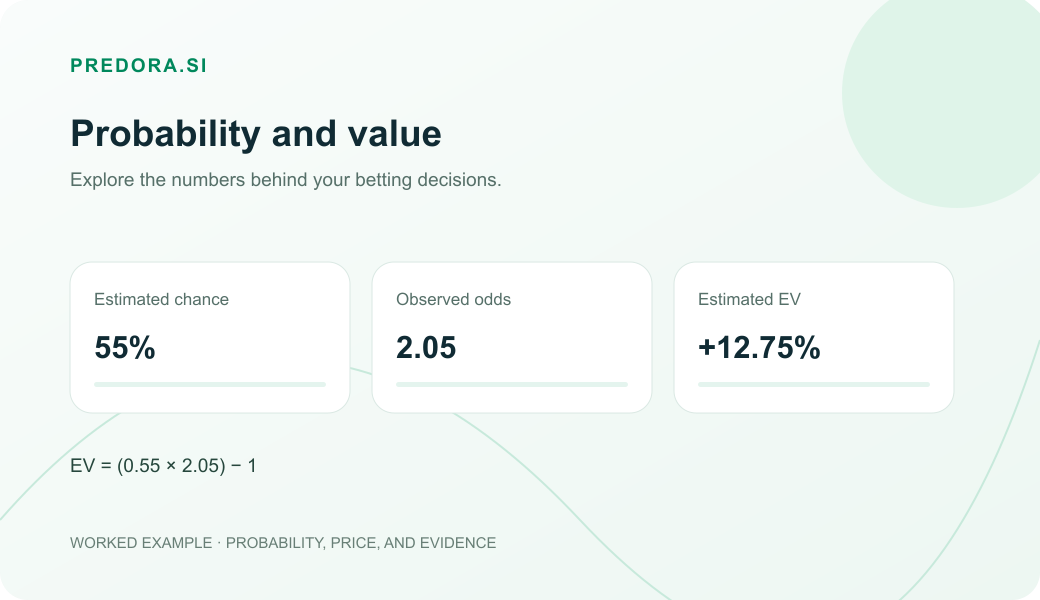
| Main formula | EV = (estimated probability × odds) − 1 |
| When value exists | When the EV is greater than zero or the bookmaker's odds are above the fair odds. |
| Common mistake | Reading value without examining the probability estimate. |
| How Predora.si helps | Organizes scenarios with positive EV in Upcoming Games with EV+ using the Active Model and the best available odds. |
A value bet is a bet in which the odds are above the estimated fair price, generating positive EV when the probability used in the calculation is well calibrated.
How does a value bet work?
A value bet comes from comparing two things:
- The estimated probability of an outcome happening.
- The offered odds by the bookmaker for that same outcome.
If the bookmaker is paying odds higher than the fair odds calculated from your probability, value may exist. The practical logic is:
- if the model estimates a higher probability than the bookmaker is pricing, there is an estimated difference;
- if the odds pay above the fair price, the EV tends to be positive;
- if the odds are below the fair price, the outcome may still happen, but the estimated value is negative.
It is not just "who wins?"
It is "are these odds paying well for the real estimated probability of this outcome?"
Value bet formula
The most practical way to measure a value bet is through EV, or expected value.
EV = (estimated probability × odds) − 1Fair odds = 1 ÷ estimated probability| Estimated probability | The probability calculated by the model. It must be entered in decimal form in the formula. E.g., 52% = 0.52. |
|---|---|
| Odds | The decimal price offered by the bookmaker for the analyzed market. |
| positive EV | Indicates that the bet has positive expectation in the long run, if the probability is correct. |
| Negative EV | Indicates that the odds do not compensate for the estimated probability. |
You can also think in terms of fair odds: if the bookmaker's odds is greater than the fair odds, a value bet may exist.
Example in football
Imagine a Brasileirão game in the market 1x2, with the selection home team wins.
Estimated probability = 52% Fair odds = 1 ÷ 0.52 = 1.92 Bookmaker odds = 2.10 EV = (0.52 × 2.10) − 1 EV = 1.092 − 1 EV = 0.092 EV = +9.2%In this example, the odds 2,10 are paying above the fair price estimated by the model. If the 52% probability is well calibrated, the scenario shows positive EV conditioned on the estimate.
What makes a price offer value?
No. That is the most common confusion.
A value bet can lose. In practice, it will lose several times. The point is that when you repeat bets with positive EV and good risk management, the mathematical expectation tends to be better than betting on guesswork.
| 52% chance | It still loses in 48 out of 100 similar scenarios. |
|---|---|
| 60% chance | It still loses in 40 out of 100 similar scenarios. |
| positive EV | Shows a price above the fair odds implied by an estimate. |
A value bet offers odds above the fair price implied by your probability estimate. Use that difference to focus your analysis on potential value.
Value bet vs. high odds
High odds do not automatically mean value.
Odds of 4.00 may look attractive, but if the real estimated probability is only 20%, the fair odds would be 5.00. In that case, 4.00 odds would be paying less than it should.
At the same time, odds of 1.75 can have value if the model estimates a high enough probability.
| Situation | Is there value? |
|---|---|
| High odds, but probability too low | Not necessarily. |
| Low odds, but very strong probability | There may be value. |
| Favorite with squeezed odds | Explore why the factors differ from the estimate. |
| Underdog with odds above the fair price | There may be value, but it tends to have more variance. |
The secret is not in the size of the odds. It is in the relationship between probability, fair price, and offered odds.
How it appears on Predora.si
On Predora.si, the value bet logic appears mainly in Upcoming Games with EV+. The page organizes scenarios in which the Active Model identifies positive EV, comparing:
- the probability estimated by the model;
- the best odds found among the monitored bookmakers;
- the selected market, such as 1X2, Double Chance, Over 2.5 goals, Both Teams to Score, or Over 9.5 corners.
1. The Active Model estimates the probability
The platform calculates the chance of the selection within the selected market.
2. Predora compares that probability with the odds
The same probability can have different EV as the best available odds change.
3. The system calculates the EV
When the EV is positive, the scenario may appear in Upcoming Games with EV+.
4. Statistical context compared
Odds, factors, statistics, and the comparison between teams contextualize the scenario.
The idea is not to follow the list automatically. The idea is to save time and start the analysis where there may be a good price.
Common mistakes about value bets
1. Skipping the estimate behind value
It is not. A value bet is a bet with positive expectation, not a certain outcome.
2. Looking only at the odds
High odds draw attention, but without an estimated probability they do not say much.
3. Confusing favoritism with positive EV
The favorite may have a higher chance of winning and still have bad odds.
4. Ignoring the selected market
A game may have no value in 1X2, but have value in Double Chance, goals, BTTS, or corners.
5. Forgetting that odds change
If the odds drop, the EV changes. A bet that was value at 2.10 may no longer be value at 1.85.
Quick checklist to identify a value bet
- Choose the market you want to analyze.
- See the estimated probability for the selection.
- Calculate or check the fair odds.
- Compare with the best available odds.
- Calculate the EV using
(probability × odd) − 1. - If the EV is positive, compare the context with factors and statistics.
- Contextualize the reading comparing probability, odds, factors, and sample.
Use the EV Calculator to test probability and odds, or see how Upcoming Games with EV+ organizes scenarios with positive EV within Predora.si.
Value Betting FAQ
What is a value bet in sports betting?
It is a bet where the odds offered are above the fair price estimated by probability. Instead of betting just because you think a team will win, you compare chance and price to see if there is an estimated difference.
Does a value bet always win?
No. Value bets also lose. The goal is to make decisions with positive expectation in the long run, accepting that football has variance and unexpected results.
How do I know if a bet has value?
Compare the estimated probability with the available odds. If the EV is positive or if the bookmaker's odds are above the fair odds, there may be value.
Is a high odd always a value bet?
No. A high odd only has value when it is above the estimated fair price. If the real chance is lower than what the bookmaker is pricing, the high odd can be a trap.
Where do I see value bets on Predora.si?
On the Upcoming Games with EV+ page, Predora.si organizes scenarios with positive EV according to the Active Model, using the best available odd for the selected market.
Next steps
Want to dive deeper into the full reasoning? Read the value betting guide in football and compare probability, fair odds, EV, and context in the same analysis.
Want to calculate it in practice? Use the EV Calculator to test the relationship between estimated probability and available odds.