Direct answer
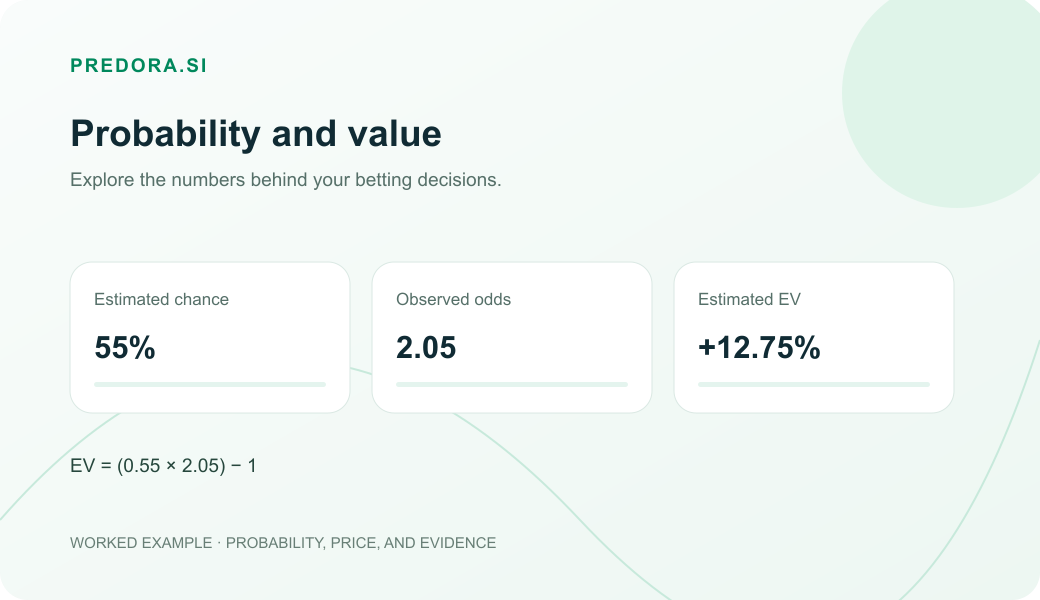
Positive EV occurs when the observed odds are above the fair odds estimated from the model's probability. In practical terms, the calculation indicates a positive divergence between estimated probability and price.
EV depends on the probability estimate used. Comparing the model’s calibration and match factors helps you assess that estimate.
Quick summary
| Definition | Positive EV is a calculation result in which the observed odds are above the fair odds estimated by the probability used. |
|---|---|
| Main formula | EV = (estimated probability × odds) − 1 |
| When +EV Exists | When EV is greater than zero or when the bookmaker's odds are above the fair odds. |
| Common mistake | Thinking that positive EV predicts the outcome. It does not: it measures an estimated relationship between probability and odds. |
| How Predora.si helps | Predora crosses the Active Model's probability with observed odds to calculate fair odds, edge, and EV in football matches. |
Positive EV occurs when the observed odds are above the fair odds estimated by the model's probability, resulting in a mathematically positive expected value.
What Does +EV Mean in Football Betting?
EV stands for Expected Value, or expected value. It measures whether a bet tends to be positive or negative in the long run, considering the estimated probability of the selection and the odds offered by the bookmaker.
In football, a high probability does not imply positive EV. The reading depends on the relationship between the estimated probability and the observed odds.
Probability answers: what is the chance of this happening?
Odds answers: what is the market paying?
EV answers: does this price make sense for this chance?
The calculation results in positive EV when the relationship between estimated probability and observed odds produces an expected value greater than zero.
How to Calculate EV in Football Betting
The standard formula is:
EV = (estimated probability × odds) − 1Use the probability in decimal format: 50% becomes 0,50, 53% becomes 0,53 and 61% becomes 0,61.
Simple example
Imagine a Brasileirão match in which the Active Model estimates 47% chance for the home team to win, and the best available odds for that selection are 2.30.
EV = (0.47 × 2.30) − 1 EV = 1.081 − 1 EV = 0.081 EV = +8.1%In this case, the calculation results in EV of +8.1%. The offered price is above the fair odds implied by this probability estimate.
Implied Probability, Fair Odds, and Edge
To identify +EV more clearly, it is worth looking at three concepts together.
Implied probability = 1 ÷ decimal oddsFair odds = 1 ÷ estimated probabilityEdge = model probability − implied probability of the oddsEV = (estimated probability × odds) − 1How This Looks in the Example
| Metric | Calculation | Outcome |
|---|---|---|
| Model probability | Independent estimate | 47,0% |
| Best bookmaker odds | Available price | 2.30 |
| Implied probability | 1 ÷ 2.30 | 43,5% |
| Fair odds | 1 ÷ 0.47 | 2.13 |
| Edge | 47,0% − 43,5% | +3.5 p.p. |
| EV | (0.47 × 2.30) − 1 | +8,1% |
With an estimated probability of 47%, the calculated fair odds are 2,13. An observed odds of 2,30 results in positive EV of +8,1% according to this estimate.
Step by Step to Analyze Positive EV
1. Define the market being analyzed
Before any calculation, define what question you are asking about the match: 1X2, Double Chance, Over 2.5 Goals, Both Teams to Score, or Over 9.5 Corners.
2. Use an estimated probability
On Predora, this probability comes from the Active Model, which is the mathematical lens used to calculate chance, fair odds, and EV.
3. Compare with the observed odds
If the model's probability is greater than the implied probability, there may be edge. If the bookmaker's odds are greater than the fair odds, there may be value.
4. Calculate the EV
Use EV = (estimated probability × odds) − 1. If the result is greater than zero, we have positive EV.
5. Review the context
Check whether the odds are still up to date, whether the market and line are the same, and whether the data used by the model remain valid.
+EV Bets Are Not the Same as High Odds
High odds do not mean value. Low odds also do not mean lack of value. It all depends on the relationship between the odds and the probability.
| Situation | EV Result | Why |
|---|---|---|
| Odds 3.50 with a real chance of 20% | Negative EV | The odds look high, but they may still pay too little for the risk. |
| Odds 1.70 with a real chance of 65% | positive EV | The odds are low, but they may be above the fair price. |
| Favorite with 70% chance and odds 1.30 | Negative EV | The chance is high, but the price may be poor. |
| Draw with 31% chance and odds 3.70 | positive EV | If the fair odds would be 3.23, the bookmaker is paying above. |
Value is not in the size of the odds. Value is in the difference between price and probability.
Difference Between +EV, High Probability, and Value Bet
| Concept | Question it answers | Example | What to compare |
|---|---|---|---|
| High probability | Does it have a good chance of happening? | Double Chance with 70% | May have low odds and negative EV. |
| +EV Bet | Are the odds paying well for this chance? | Chance 50%, odds 2.15 | It can lose in the short term. |
| Value bet | Is the price above the estimated fair price? | Fair odds 1.80, bookmaker pays 2.05 | It depends on the quality of the probability. |
| High odds | How much does it pay if it hits? | Odds 4.00 | Does not mean it is underpriced. |
How to interpret EV across a series of bets
Because EV works with expectation, measured across a series. If a bet has 55% chance, it still loses in 45 out of every 100 similar scenarios.
In football, this weighs even more because of variance: few goals, frequent draws, red cards, penalties, injuries, lineup changes, home advantage pressure, weather, schedule, and small samples in some leagues.
To interpret EV, the relevant question is not predicting the event's outcome, but comparing the observed odds with the estimated fair odds.
How to Interpret +EV in the Long Run
EV describes an expected average across comparable bets. Reviewing a series helps you see how actual results vary around that expectation.
Sample
A larger sample helps separate signal from noise. Twenty observations can fluctuate a lot.
Return
Hit rate alone does not tell the whole story. Return depends on the odds captured.
Market and League
A model may perform better on goals than on 1X2, or better in a specific league.
EV Size
High EV values may reflect a relevant divergence, but they may also indicate the need for additional review of the odds, market, line, data, or model.
How to Analyze EV on Predora.si
On Predora.si, EV is presented as an analytical indicator that relates estimated probability, fair odds, and observed odds, along with statistical data and historical performance.
1. Start with the Active Model
The Active Model calculates probability, fair odds, and EV in the selected market. Switching the model changes the probability and, consequently, changes the EV.
2. Check the EV analysis
EV+ brings together matches where the Active Model’s estimated probability and current odds produce positive expected value. Explore each match to compare the price and supporting factors.
3. Compare the odds
Differences in odds change the calculated EV for the same estimated probability.
4. Check AI + Statistics
Review home advantage, recent form, goals scored and conceded, xG or creation proxy, corners, BTTS, league average, and sample.
5. Check Performance by league
Performance by league lets you compare sample size, hit rate, and historical Return to see where the Active Model has performed more consistently.
6. AI Radar as a Complementary View
AI Radar uses historical performance segments to help you discover current matches worth exploring in more detail.
Hypothetical educational example: EV calculation in the Brasileirão
Imagine a Brasileirão Série A match in the market Over 2.5 goals. The Active Model estimates 54% probability for Over 2.5, and the best available odds are 2.05.
Fair odds = 1 ÷ 0.54 Fair odds = 1.85 EV = (0.54 × 2.05) − 1 EV = 1.107 − 1 EV = +10.7%In this hypothetical example, the calculation results in a positive EV of +10.7%. The interpretation remains conditioned on the quality of the data, the estimated probability, and the odds used.
- Do both teams shoot a lot?
- Do both teams concede goals frequently?
- Does the league's goal average help?
- Does recent form converge with the estimate or diverge from it?
- Are the odds still 2.05?
- Is there relevant lineup news?
Common Mistakes When Interpreting Positive EV
1. Thinking positive EV predicts the outcome
EV measures the expected average return implied by a probability estimate and price.
2. Confusing high odds with value
High odds, in isolation, do not indicate positive EV. The calculation depends on the relationship between the odds and the estimated probability.
3. Using implied probability as real chance
To calculate EV, you need an independent estimate, such as the model's probability.
4. Ignoring the selected market
EV in 1X2 does not apply to Over 2.5. EV in BTTS does not apply to corners.
5. Compare different markets
Over 2.5 and BTTS may seem similar, but they are not the same bet.
6. Forgetting that odds change
EV can be positive at one moment and change when the odds are updated.
7. Looking at only a single isolated bet
The result of a single event neither validates nor invalidates a model. Evaluation requires a basis of observations.
Practical checklist for analyzing positive EV
- Clear market: 1x2, Double Chance, Over 2.5, BTTS or corners.
- Estimated probability: use a model or structured reading, not a standalone odd.
- Comparable odds: compare the same game, market, and line.
- Calculated fair odds: use
1 ÷ estimated probability. - Implied probability compared: use
1 ÷ odd. - EV greater than zero: calculate with
EV = (probability × odds) − 1. - Positive edge: check whether the model's chance exceeds the chance embedded in the odd.
- Updated odds: EV changes when the odds change.
- Factors supporting the reading: compare data, context, and sample.
- Limits of the indicator: Compare EV with the probability estimate and match context to assess the price.
EV analysis flow at Predora.si
Access the EV analysis
Start with the results where the Active Model calculated positive EV.
Define the market being analyzed
Filter by the market you want to analyze and the leagues you follow most closely.
Open the game data
Check the best odd and whether the price is still valid.
Compare the numbers
See probability, fair odds, edge, and EV in the same market.
Check the factors
AI + Statistics, league performance, and context complement the comparison.
Interpret the result
Use EV to compare the price with your estimated probability, then investigate the match evidence.
How should EV magnitude be interpreted?
There is no magic number. The higher the calculated EV, the greater the divergence between the estimated probability and the observed odds. High values also require additional review of the data, the model, the market, and the line.
| EV range | Analytical reading |
|---|---|
| 0% to +2% | Small divergence; sensitive to odds variations and estimation error. |
| +2% to +7% | Moderate divergence; depends on model calibration and data updates. |
| +7% to +15% | High divergence; requires additional review of the model, the odds, and the market. |
| Above +15% | Very high divergence; review data, line, odds, and context before interpreting. |
EV varies according to the observed odds
For the same estimated probability, different odds produce different EV values.
| Estimated probability | Odds | EV |
|---|---|---|
| 52% | 1.85 | -3,8% |
| 52% | 1.95 | +1,4% |
| 52% | 2.05 | +6,6% |
Same estimated probability, different odds, and different EV results.
FAQ about +EV betting
What does positive EV mean?
Positive EV means the odds exceed the fair price implied by your probability estimate. It expresses a favorable expected average under those assumptions.
How do I know if a calculation has positive EV?
Compare the estimated probability with the offered odd. The formula is EV = (estimated probability × odds) − 1. If the result is greater than zero, the bet has positive EV.
What does a +EV bet tell me?
It tells you the offered price exceeds the fair odds implied by your probability estimate. Use that comparison to focus your research on potential value.
What is the difference between a +EV bet and a high-probability bet?
A high-probability bet has a greater chance of happening. A +EV bet is one where the odd is paying well for the estimated chance. A bet can have high probability and negative EV if the odd is too low.
Does a high odd always mean value?
No. A high odd only means a higher payout if it wins. To be value, the odd must be above the fair odd estimated by the model's probability.
Why can EV change?
Because odds change. If the bookmaker lowers the odd, EV can drop or even turn negative. That is why it is important to check the price at the time of the decision.
Use EV to investigate the price
At Predora.si, estimated probability, fair odds, EV, and observed odds are presented for comparison and statistical analysis by market. These indicators depend on the model used and can change with new data and updated odds.