Direct answer
Edge in betting is the difference between the estimated probability of an outcome and the implied probability of the odds offered by the bookmaker. When the edge is positive, the model is saying that the estimated chance is higher than what the bookmaker's price suggests.
In plain English: the odds may pay more than the fair price implied by your estimate. Edge makes that probability gap visible.
Quick summary
| Term | Edge. |
|---|---|
| Category | Value and EV. |
| Definition | Difference between the estimated chance and the chance implied in the odds. |
| Formula | Edge = estimated probability − implied probability |
| When it is positive | When the estimated probability is higher than the implied probability. |
| Common mistake | Reading edge without checking the probability estimate. |
| How Predora.si helps | Shows the Active Model's chance, best available odds, fair odds, EV, and estimated difference per market. |
Edge is the advantage in percentage points between the chance the model estimates and the chance the bookmaker's odds are pricing in.
How it works
Think of edge as a comparison between what the model sees and what the bookmaker is pricing in.
On one side, you have the estimated probability: the chance the model gives for that selection within the analyzed market.
On the other side, you have the implied probability of the odds: the chance embedded in the price offered by the bookmaker.
Positive edge means the model's probability estimate exceeds the probability implied by the odds. Explore that gap alongside match factors and model history to assess the price.
Edge formula
Edge = estimated probability − implied probabilityImplied probability = 1 ÷ decimal odds| Edge outcome | What it means |
|---|---|
| Positive edge | The estimated probability is higher than the implied chance of the odds. There may be an estimated difference. |
| Edge close to zero | The model and the bookmaker are seeing the price in a similar way. |
| Negative edge | The odds are paying less than the estimated probability suggests. In general, there does not seem to be value. |
Example in football
Imagine a Brasileirão game in the market 1x2, with the selection home team wins.
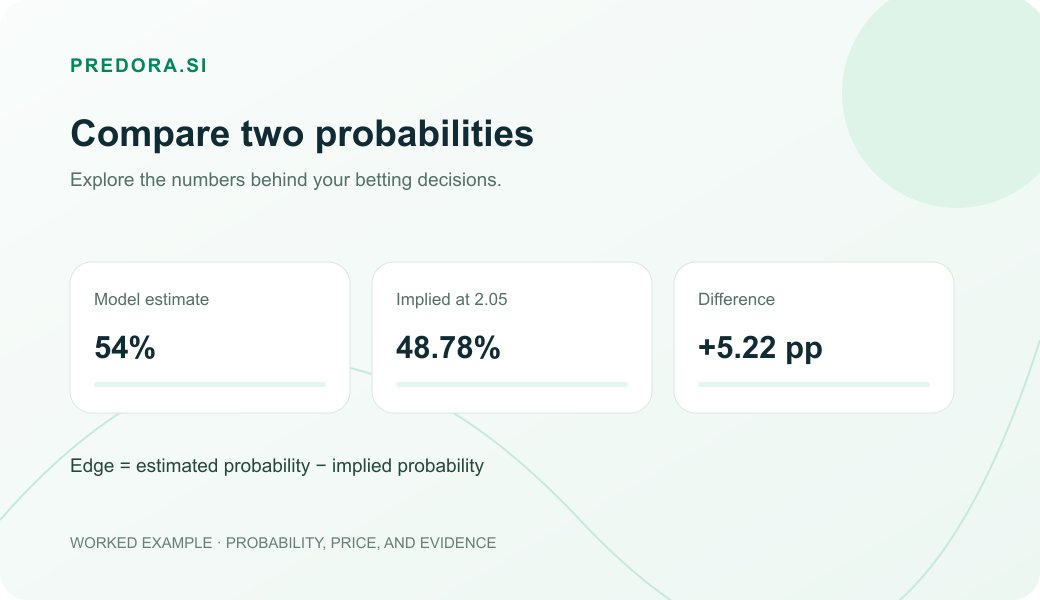
Estimated probability = 54% Odds = 2.05 Implied probability = 1 ÷ 2.05 Implied probability = 48.78% Edge = 54% − 48.78% Edge = +5.22 percentage pointsIn this example, the edge is positive. The model estimates that the home team has 54% chance, while the bookmaker's odds are pricing that outcome as if it had about 48,78% of chance.
In simple terms: the bookmaker is paying as if the outcome were less likely than the model estimates. This may signal a value divergence under this estimate.
Is edge the same thing as EV?
No. They are close, but they are not the same thing.
| Concept | What it measures | Formula |
|---|---|---|
| Edge | Difference between estimated probability and implied probability. | estimated probability − implied probability |
| EV | Expected average return of the bet. | (estimated probability × odds) − 1 |
| Fair odds | Odds consistent with the estimated probability. | 1 ÷ estimated probability |
Edge shows the advantage in terms of probability. EV turns that advantage into return expectation. In practice, when the edge is positive, EV tends to improve; still, the two metrics measure different aspects of the comparison.
How it appears on Predora.si
On Predora.si, the edge appears as estimated difference within the game analysis. The app compares:
- the Active Model's chance;
- the implied probability of the best odds found;
- the fair odds estimated by the model;
- the EV of that selection.
1. The model estimates the chance
The reading starts with the probability of the selection in the selected market.
2. The odds become implied probability
The best available odds are converted into chance to compare price and probability.
3. The edge shows the difference
If the model's chance is higher than the bookmaker's chance, there is positive edge.
4. EV completes the reading
Then, EV helps understand the expected impact of the odds on that selection.
The logic is simple: if the model's probability is higher than the bookmaker's implied probability, there is edge. If the odds also generate positive EV, that game may appear as a highlighted scenario in readings such as Upcoming Games with EV+.
Common mistake
The most common mistake is thinking that positive edge means a sure bet. That's not it.
A selection with a 54% chance can still lose 46 times in 100 similar games. Football has missed goals, red cards, deflected shots, penalties, VAR, disrupted play, and variance.
Edge shows the gap between estimated and implied probability. Compare the model, match factors, and price to understand what drives it.
Practical checklist
- Check the estimated probability from the model to the selected market.
- See the best available odds for the same selection.
- Calculate the implied probability of those odds.
- Measure the edge in percentage points.
- Check whether the EV is also positive, because edge and EV complement each other.
- Compare the analyzed market for that specific game.
- Review factors and statistics instead of looking only at a single isolated number.
FAQ about edge in betting
Does a positive edge mean the bet will win?
A positive edge means estimated probability exceeds the probability implied by the odds. Use it to identify a price difference worth investigating.
Are edge and estimated difference the same thing?
In analytical use, yes. Edge is a way to measure the estimated difference between the chance calculated by the model and the chance priced by the bookmaker.
Is edge calculated as a percentage?
Normally, edge is read in percentage points. Example: if the model estimates 54% and the odds imply 48.78%, the edge is +5.22 percentage points.
Is edge better than EV?
It is not a matter of better or worse. Edge shows the probability difference. EV shows the expected return using the odds. For a complete analytical reading, it makes sense to look at both.
Can I use edge in any football market?
Yes, as long as you have an estimated probability and odds for the same market. On Predora.si, this reading should be done within the selected market, such as 1X2, Double Chance, Over 2.5 goals, Both teams to score, or Over 9.5 corners.
Next steps
To put the concept into practice, start with the implied probability of the odds and then compare it with the estimated probability from the model. If the difference is positive, use EV to complete the analysis.
Within Predora.si, use the Active Model, the odds comparison, and Upcoming Games with EV+ as a starting point to find games with possible estimated value.