Direct answer
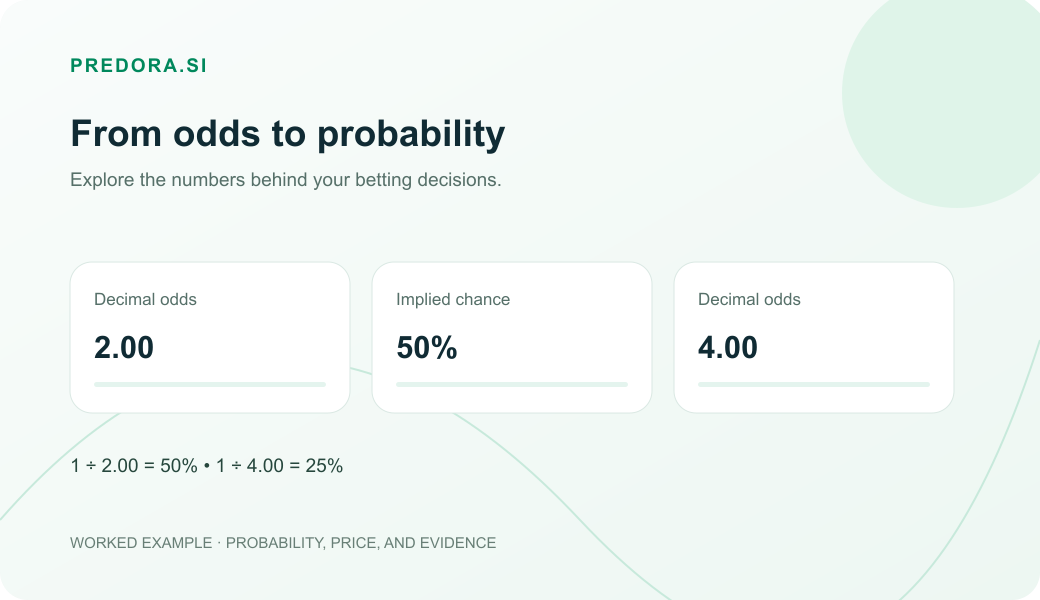
Implied probability is the chance that an odd is embedding in the bet price. In decimal odds, the calculation is simple: implied probability = 1 ÷ odd. Then, just convert it to a percentage. For example, odds of 2.00 represents 50% of implied probability.
Quick summary
| What is | The chance that the bookmaker's odd is pricing for a result. |
|---|---|
| Formula | Implied probability = 1 ÷ decimal odds |
| As a percentage | (1 ÷ decimal odd) × 100 |
| Example | Odd 2.00 becomes 50% implied probability. |
| When to use | To compare the bookmaker's price with the probability estimated by your model. |
| Common mistake | Thinking implied probability is the real chance of the game. It is the bookmaker's price, with margin. |
| How Predora helps | Shows chance, best odd, fair odd, edge and EV to compare price and probability. |
Implied probability is the conversion of an odd into a percentage to understand what chance that price is suggesting.
Why convert odd into chance?
Think of the odd as the price of the bet. Implied probability translates that price into a language that is easier to compare: chance as a percentage.
This matters because, in football betting, it is not enough to look at whether the odd is high or low. The central point is understanding whether that odd is paying well for the estimated chance of that market.
A high odd can look attractive and still be expensive. A low odd can look uninteresting and still be good, if the estimated chance is higher than what the price suggests.
Implied probability formula
The formula for decimal odds is:
Implied probability = 1 ÷ decimal oddsImplied probability (%) = (1 ÷ decimal odd) × 100Simple example
Odds = 2.50 1 ÷ 2.50 = 0.40 0.40 × 100 = 40%So, an odd 2.50 represents 40% of implied probability.
Quick table: decimal odds into probability
| Decimal odds | Implied probability |
|---|---|
| 1.25 | 80,0% |
| 1.50 | 66,7% |
| 1.67 | 59,9% |
| 1.80 | 55,6% |
| 2.00 | 50,0% |
| 2.20 | 45,5% |
| 2.50 | 40,0% |
| 3.00 | 33,3% |
| 4.00 | 25,0% |
| 5.00 | 20,0% |
The higher the odd, the lower the implied probability. The lower the odd, the higher the implied probability.
Example in football
Imagine a Brasileirão match with the market 1x2:
| Outcome | Bookmaker odd | Implied probability |
|---|---|---|
| Home team wins | 2.10 | 47,6% |
| Draw | 3.30 | 30,3% |
| Away team wins | 3.60 | 27,8% |
Home: 1 ÷ 2.10 = 47.6% Draw: 1 ÷ 3.30 = 30.3% Away: 1 ÷ 3.60 = 27.8% 47.6% + 30.3% + 27.8% = 105.7%Going over 100% is normal in markets like 1x2. That difference is the bookmaker margin, also called overround.
Implied probability is not real chance
This is the point that separates those who look at odds on impulse from those who start thinking with method. Implied probability shows what the odd is saying, not necessarily what will happen.
| Concept | What it means |
|---|---|
| Implied probability | Chance suggested by the bookmaker's odd. |
| Model probability | Chance estimated by a statistical model. |
| True chance | The probability estimated from your model, match data, and context. |
In the real world, you work with estimates. The goal is to compare good estimates with good prices.
How to know if an odd might be paying well?
The basic logic is this:
If the estimated probability is higher than the implied probability, there may be value.
| Bookmaker odd | 2.20 |
|---|---|
| Implied probability | 45,5% |
| Probability estimated by the model | 52,0% |
| Difference | +6.5 percentage points |
Here, the bookmaker is pricing as if that result had 45,5% chance. But the model estimates 52%. This difference is the edge, or estimated difference.
Implied probability, fair odd and EV
| Concept | Formula | What it's for |
|---|---|---|
| Implied probability | 1 ÷ bookmaker's odd | Understand what chance the odd is pricing. |
| Fair odds | 1 ÷ estimated probability | Understand what odd would be fair for your estimated chance. |
| EV | (estimated probability × odds) − 1 | Measure whether the bet has positive or negative expected value. |
Complete example
| Model probability | 55% |
|---|---|
| Fair odds | 1 ÷ 0.55 = 1.82 |
| Odds offered by the bookmaker | 2.05 |
| Implied probability of the odds | 1 ÷ 2.05 = 48.8% |
| Edge | 55.0% − 48.8% = +6.2 p.p. |
| EV | (0.55 × 2.05) − 1 = +12.75% |
The bookmaker is paying 2.05, but if your model is well calibrated, the fair price would be around 1.82. That's where a value bet can be born.
How to interpret this in the long run
Probability describes the likelihood of an outcome. An event with 60% chance can still lose many times in a short sample. In football, a missed penalty, a red card or a set piece can completely change a game.
- Convert the odd into chance.
- Compare with an estimated probability.
- Measure edge and EV.
- Compare the context of the game.
- Repeat good decisions in the long run.
Compare the implied probability with your estimate to see how the offered price measures up.
How to apply it on Predora.si
In the Predora.si, implied probability appears in practice when you compare the best available odd with the chance estimated by the Active Model.
1. Active Model estimates the chance
The model calculates the probability for the selected market.
2. Odds Comparison finds the price
The best available odd directly changes the implied probability.
3. Edge shows the difference
The difference between the model's chance and the odd's chance indicates a possible advantage.
4. EV measures the expected value
EV helps separate an interesting price from a merely intuitive selection.
5. AI + Statistics contextualizes the estimate
Match factors help verify the context and the limits of the reading.
Practical example
You are looking at the market Over 2.5 goals.
| Best odd found | 1.95 |
|---|---|
| Implied probability | 51,3% |
| Active Model chance | 57,0% |
| Edge | +5.7 p.p. |
| Approximate EV | +11,15% |
In this scenario, the odd may be paying above the estimated fair price. Still, it is worth reviewing attacking creation, goals scored, goals conceded, recent form, league average and market signals.
Predora connects bookmaker prices with model probabilities and match evidence, helping you explore where the market and your analysis differ.
Common mistakes when using implied probability
1. Thinking a high odd is automatically good
A high odd pays more because, in general, it represents something less likely. The right question is whether the estimated chance is higher than the implied chance.
2. Confusing implied probability with real probability
The odd shows the bookmaker's price. It does not reveal the absolute truth of the game.
3. Forgetting the bookmaker margin
In markets with multiple outcomes, like 1x2, the sum of implied probabilities usually goes over 100%.
4. Comparing different markets as if they were the same
Odd 1.80 in 1x2 is not the same as odd 1.80 in Over 2.5 goals. Always compare the same game, market and line.
5. Ignoring the best available odd
The same bet can be 1.85 at one bookmaker and 2.00 at another. That difference weighs heavily in the long run.
6. Skipping the estimate behind EV
Positive EV indicates that the odd may be paying above fair, but the bet can still lose.
Practical checklist for converting odds into chance
- Identify the market being analyzed: 1x2, Double Chance, Over 2.5 goals, Both Teams to Score or Over 9.5 corners.
- Look at the decimal odd: for example, odd 2.20.
- Convert into implied probability:
1 ÷ 2.20 = 45.5%. - Compare with an estimated probability: for example, your model estimates 52%.
- Calculate the edge:
52.0% − 45.5% = +6.5 p.p.. - Calculate or check the EV:
EV = (0.52 × 2.20) − 1 = +14.4%. - Interpret the context of the game: factors, recent form, home/away, market statistics and sample quality affect the comparison.
- Explore the match: compare the probability estimate with current context and model history.
Quick example for each market
| Market | Odds | Implied probability | How to interpret |
|---|---|---|---|
| 1x2 | 2.40 | 41,7% | The bookmaker prices this result as less likely than 50%. |
| Double Chance | 1.45 | 69,0% | More protected market, usually with a lower odd and higher implied chance. |
| Over 2.5 goals | 1.90 | 52,6% | The bookmaker suggests a game slightly above 50% for 3 or more goals. |
| Both Teams to Score | 1.85 | 54,1% | BTTS needs to happen more than half the time to be fair. |
| Over 9.5 corners | 2.05 | 48,8% | The bookmaker prices over corners as slightly below 50%. |
FAQ about implied probability
What is implied probability?
Implied probability is the chance that an odd is suggesting. In decimal odds, you calculate it by dividing 1 by the odd. For example, odd 2.00 represents 50% implied probability.
How to convert odds into percentage?
Use the formula Implied probability (%) = (1 ÷ decimal odd) × 100. Example: odds of 2.50 become 1 ÷ 2.50 = 0.40, or 40%.
Is implied probability the real chance of the game?
Implied probability converts a bookmaker’s price into a percentage. Compare it with a model estimate to investigate the difference between your view and the market.
Why does the sum of probabilities exceed 100% in 1x2?
Because odds usually include the bookmaker's margin. In a 1x2 market, the implied probabilities of home, draw and away usually add up to more than 100%. That excess is the margin, or overround.
How does Predora.si use this concept?
Predora compares the Active Model probability with the best odd found at monitored bookmakers. This comparison helps calculate edge and EV in flows like Upcoming Games and Upcoming Games with EV+.
Closing
Implied probability is the first step to stop looking at odds in the dark. It turns the odd into chance, helps you understand the bookmaker's price and paves the way to compare that price with the probability estimated by the model.
Predora brings together model probability, bookmaker odds, fair odds, edge, EV, and match factors so you can evaluate the price with a fuller picture of the game.