Direct answer
CLV, or Closing Line Value, compares the odds you got with the closing odds of the same market before the game starts.
In plain English: CLV shows whether you got a better price than what the market later came to offer.
Quick summary
| Full name | Closing Line Value. |
|---|---|
| What it measures | Whether the odds you bet were better or worse than the market's final odds. |
| Good sign | Your odds were higher than the closing odds for the same selection. |
| Common mistake | Assessing CLV from the result of one match. |
| How Predora.si helps | Comparing odds, highlighting the best odds and showing chance/EV per market. |
How does CLV work?
CLV works like a price thermometer. If you take an odd early and, close to the start of the match, the same selection starts paying less, you beat the closing line.
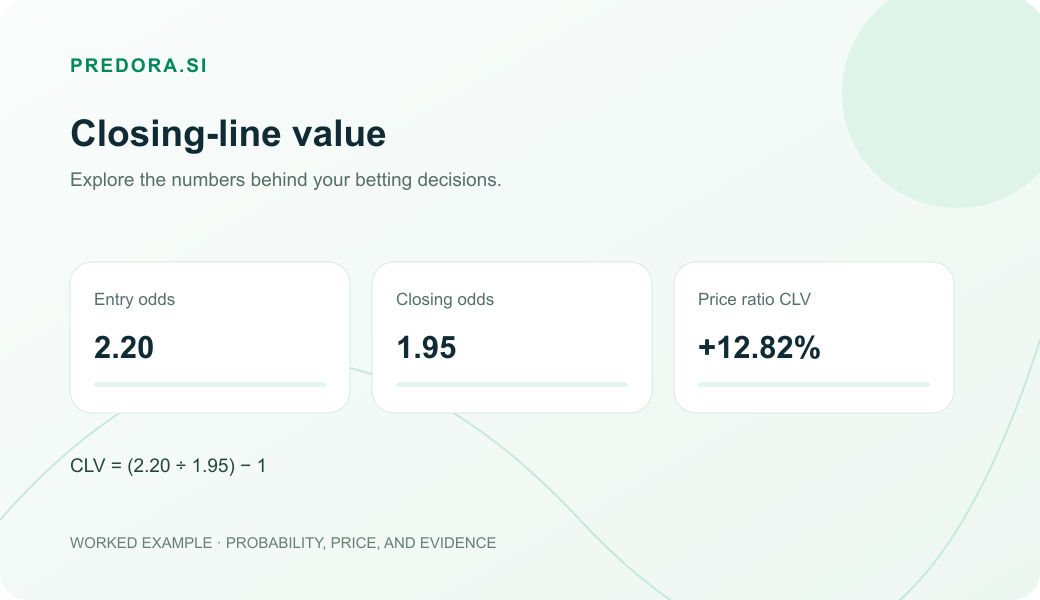
Entry: home team wins at odd 2.20Closing: home team wins at odd 1.95The question is not whether the bet won or lost. The question is whether you got a good price relative to the final market.
CLV formula
Implied probability = 1 / decimal odd CLV = closing implied probability - implied probability of the bet odd| Outcome | Reading |
|---|---|
| Positive CLV | You got a better price than the closing line. |
| Negative CLV | The market offered a better price after your entry. |
| CLV close to zero | The price barely moved against or in your favor. |
The comparison must be for the same match, market, selection and line.
Example in football
Imagine you entered Home team wins at odd 2.20. Near the start of the game, the closing odd for the same selection is at 1.95.
Implied probability of the bet odd = 1 / 2.20 = 45.45% Closing implied probability = 1 / 1.95 = 51.28% CLV = 51.28% - 45.45% = +5.83 percentage pointsYou took an odd that priced the outcome at 45.45% chance. Closer to the match, the market closed pricing it near 51.28%. This indicates positive CLV.
CLV vs EV
| Metric | What it asks | When it appears |
|---|---|---|
| EV | How does the current odd compare with the estimated probability? | In the analysis of the current price. |
| CLV | Was the recorded odd better than the closing one? | After the market moved. |
| ROI | Did the set of bets generate a return? | After a sample of bets. |
How to interpret with Predora.si
Predora.si organizes references to compare odds, probability and EV per market before evaluating the closing price.
- Identify the market and selection in the analyzed record.
- Check the Active Model chance, EV and the available odd reference.
- Consider the recorded odd and the time of that observation.
- Compare with the closing odd of the same selection and line.
- Interpret CLV over a sample, not by an isolated record.
Positive CLV shows you took a better price than the closing line. Track it across comparable bets to review the quality of your pricing process.
FAQ about CLV
Does positive CLV mean the bet will win?
Positive CLV measures a price advantage over the closing line. Review it across a series alongside your results.
Does negative CLV mean the bet was bad?
Not necessarily, but it can signal a recorded price worse than the closing line.
Is CLV more important than EV?
No. They are complementary metrics: EV before the decision, CLV after the market moves.
Does CLV work in football betting?
Yes, as long as you compare the same match, market, selection and line.
CLV measures price process
CLV is useful for evaluating whether recorded prices tend to be favorable relative to the closing line. It does not replace EV, sample, ROI, variance and bankroll management.