Direct answer
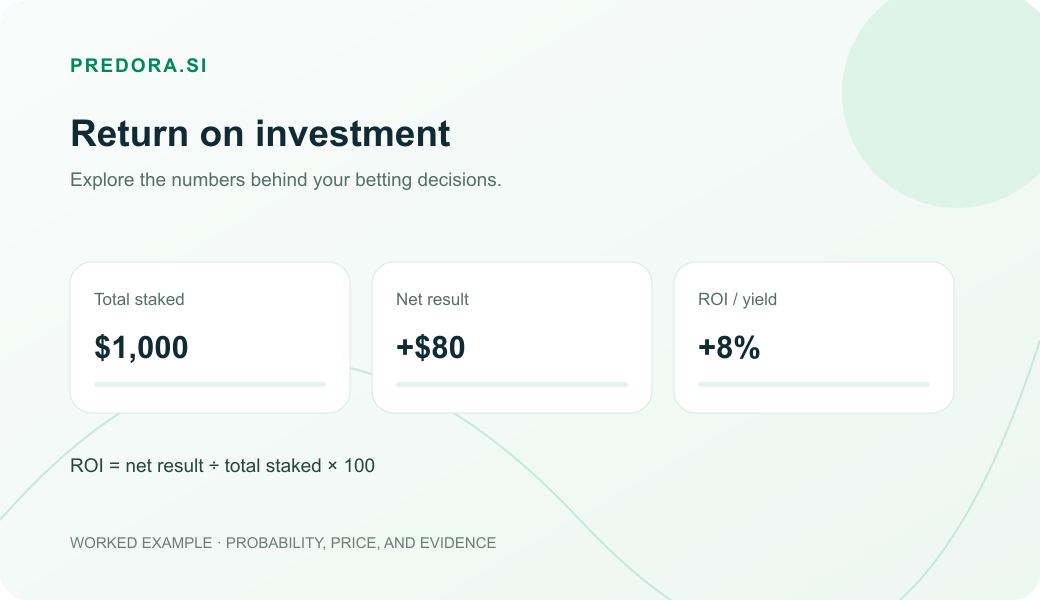
ROI in betting is the return on investment of a strategy. It shows, as a percentage, how much you gained or lost relative to the total staked.
Instead of looking only at how many bets hit, ROI considers the financial result of the set, including odds, stake, volume, and net balance.
Quick summary
| Term | ROI, or return on investment. |
|---|---|
| Category | Performance metrics. |
| Used for | Measure whether a strategy ended positive or negative relative to the total amount staked. |
| Formula | ROI = (net balance ÷ total staked) × 100 |
| Good sign | Positive ROI in a relevant sample of comparable bets. |
| Common mistake | Assessing a high ROI without checking sample size and time period. |
| On Predora.si | Appears as Return, Performance, and Return History of the models. |
ROI in betting measures the net balance of a strategy relative to the total staked, showing whether the set generated a positive or negative return after odds, stakes, and losses.
How ROI works in betting
ROI is a performance metric. It answers a direct question:
After all the bets in this filter, did my result compensate for the total amount I risked?
The basic reading is simple:
- if the ROI is positive, the set ended above the total invested;
- if the ROI is negative, the set ended below the total amount invested;
- if the ROI is close to 0%, the result was practically at breakeven.
The important point is that ROI does not look only at "did I hit or miss." It looks at the impact of the odds on the result. Two strategies can have the same hit rate and very different ROIs.
ROI formula
ROI = (net balance ÷ total staked) × 100ROI = (units won or lost ÷ units staked) × 100| Net balance | Total received minus total staked. |
|---|---|
| Total staked | Sum of all stakes used in the period or filter. |
| ROI | Percentage result of the strategy. |
ROI example in football
Imagine you placed 100 football bets, always with 1 unit per bet.
| Total staked | 100 units. |
|---|---|
| Final net balance | +8 units. |
ROI = (8 ÷ 100) × 100 ROI = 8%In this case, the strategy had ROI of +8%.
Now a negative sample
| Total staked | $1.000. |
|---|---|
| Total received | $940. |
| Net balance | -$60. |
ROI = (-60 ÷ 1,000) × 100 ROI = -6%Here the ROI was -6%, meaning the strategy ended negative in that filter.
ROI vs hit rate
ROI and hit rate tell different stories.
| Metric | What it measures | Limitation |
|---|---|---|
| Accuracy rate | How many bets hit. | Does not consider whether the odds were worthwhile. |
| ROI | Financial result on the total amount staked. | It can fluctuate a lot in small samples. |
The hit rate shows consistency. ROI shows economic quality. Hitting 60% of bets at very low odds may not generate good returns; hitting 45% at better odds can generate positive ROI, depending on the prices.
ROI vs yield
In the betting market, ROI and yield often appear almost as synonyms. In many contexts, both measure net profit relative to the total staked.
Yield = net profit ÷ total stakedROI = net profit ÷ total stakedIn practice, the most important thing is to maintain consistency: always use the same formula and compare strategies within the same standard.
How ROI appears in Predora.si
In Predora.si, the concept appears mainly as Return, Performance and Return History.
The Return History shows, week by week, the result a model would have presented based on the odds of the games in that period. The comparison allows you to ask:
Does this model only hit, or does it also generate returns?
The reading can be filtered by:
- market, such as 1x2, Double Chance, Over 2.5 goals, Both teams to score, or Over 9.5 corners;
- league;
- AI Radar;
- filter All, High Prob., or Value (EV+).
This matters because ROI changes quite a bit depending on the filter. Comparing ROI of "All" with ROI of "EV+", for example, can give a skewed reading. The ideal is to compare models and strategies always within the same filter.
Another point: Predora's Return considers odds. When the platform compares bookmakers, the logic seeks to use the best available odd, because getting a better price directly changes the long-term result.
Common mistakes when interpreting ROI
1. Evaluating ROI from one match
ROI describes the result of a set of bets. Compare more periods and similar filters to assess how consistently an approach performed.
2. Comparing ROI from different segments
You cannot fairly compare ROI in EV+ against ROI in All if the volume, market, and league are different.
3. Ignoring sample size
ROI in a few bets can be unstable. A high odd that hits or an upset that loses can distort the number quite a bit.
4. Looking at ROI without looking at odds
ROI depends directly on the odds. Two people can bet on the same selection, but with different odds, and end up with different results in the long run.
5. Confusing ROI with hit rate
A high hit rate is useful, but it is not enough. In betting, the price matters. If the odd pays too little, a good hit rate may still not be worthwhile.
Practical checklist for interpreting ROI
- See the period analyzed.
- Check the total staked.
- Calculate the net balance.
- Apply the ROI formula.
- Look at the betting base before drawing conclusions.
- Only compare similar segments: same market, league, filter, and model.
- Use hit rate as support, not as a final answer.
- Read ROI alongside its sample size, time period, and staking assumptions.
The EV Calculator shows expected value and estimated ROI percentage based on probability, decimal odds, and stake.
FAQ about ROI in betting
Is ROI in betting the same as profit?
Not exactly. Profit is the absolute amount won or lost. ROI is that result as a percentage of the total amount staked. A profit of $100 can be great if you staked $500, but much smaller if you staked $10,000.
Does a positive ROI mean the strategy is good?
It is a good sign, but it needs context. A positive ROI over a few bets can be variance. Ideally, look at it together with the base, market, odds, period, and consistency.
Is ROI more important than hit rate?
For evaluating financial results, yes. Hit rate shows how many bets won, but ROI shows whether the odds compensated. In value betting, hitting more bets does not automatically mean performing better.
How to calculate ROI in football betting?
Add up everything you staked, calculate the net balance, and divide that balance by the total staked. Then multiply by 100: ROI = (net balance ÷ total staked) × 100.
Does a negative ROI mean the model is bad?
Not necessarily. It could be a rough patch, a small sample, a difficult segment, or normal football variance. Ideally, analyze the history, base, market, league, and whether the bets had positive expected value.
Next steps
Use ROI to evaluate the whole set, not an isolated bet. Always compare within the same market, league, model, and filter, and read the return together with the base, odds, EV, and hit rate.
In the app, Performance and Return History allow comparing Hit Rate, Base, and simulated historical results within the same segment.