Direct answer
Upcoming Games with EV+ is the Predora.si page that shows scenarios where the estimates from the Active Model result in positive EV, that is, situations where the best available odds may be paying above the estimated fair price.
EV+ helps you discover prices above the Active Model’s estimated fair odds. Open a match to compare its probability, price, and supporting evidence.
Quick summary
| Point | What it means |
|---|---|
| What is Upcoming Games with EV+? | A list of scenarios with positive EV in the selected market. |
| Main formula | EV = (estimated probability x odds) - 1 |
| Analytical role | Compare observed odds with the estimated fair price. |
| What to look at first | Active Model, market, league, chance, EV, best odds, sample, hit rate, and simulation. |
| Common mistake | Reading EV without checking the model’s assumptions. |
| How Predora helps | Cross-references model probability, best available odds, EV, history, and statistical factors. |
What is Upcoming Games with EV+?
Upcoming Games with EV+ is the Predora.si area that organizes scenarios with possible estimated value. In practice, it filters the game grid and shows only the analyzed results where the Active Model sees positive EV, also called EV+.
In plain English: Upcoming Games with EV+ shows situations where the bookmaker's odds may be paying more than they should, considering the probability estimated by the model.
In football, the question is not just "who will win?". In value betting, the question becomes: "are the odds paying well for the real chance of this scenario happening?"
How is EV calculated?
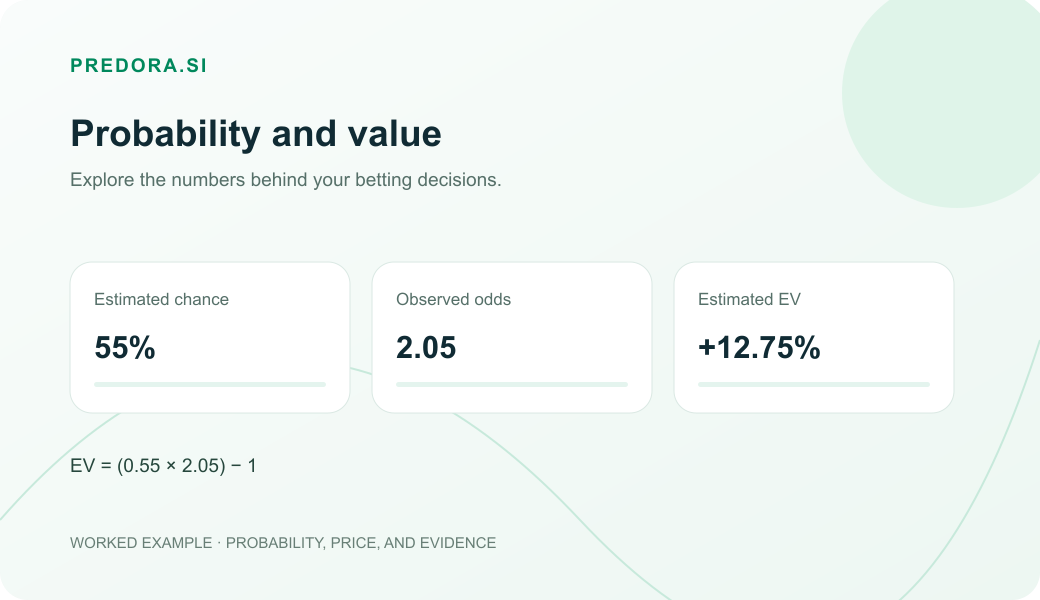
The main logic is simple:
EV = (estimated probability x odds) - 1| Estimated probability | Chance calculated by the Active Model for that analyzed outcome, always within the selected market. |
|---|---|
| Odds | Best available odds among the bookmakers compared by Predora.si. |
| EV | Expected value of the bet. If it is greater than zero, there is positive EV. |
Quick example:
Model probability: 50% = 0.50 Available odds: 2.15 EV = (0.50 x 2.15) - 1 EV = 1.075 - 1 EV = 0.075 EV = +7.5%In this example, the bet has Positive EV of +7.5%. According to this estimate, the odds exceed the fair price. Compare the match factors and model history to investigate the opportunity.
Fair odds, implied probability, and edge
To understand Upcoming Games with EV+ without getting lost, keep these three ideas in mind:
| Concept | Formula | Practical reading |
|---|---|---|
| Implied probability | 1 / odds | Chance that the bookmaker's odds are pricing in. |
| Fair odds | 1 / estimated probability | Odds consistent with the chance calculated by the model. |
| Edge | Model probability - implied probability | Difference between what the model estimates and what the odds are saying. |
Imagine a hypothetical Brasileirão Série A game in the market Double Chance.
| Probability estimated by the model | 60% |
|---|---|
| Best available odds | 1,80 |
| Implied probability of the odds | 55,6% |
| Model fair odds | 1,67 |
| EV | +8,0% |
| Edge | +4.4 p.p. |
The model estimates a 60% chance. The 1.80 odds price something close to 55.6%. Since the model's chance is higher than the chance embedded in the odds, there is an estimated difference.
How to use Upcoming Games with EV+ step by step
1. Check the Active Model
The Active Model is the mathematical lens that calculates probability, fair odds, EV, scenario ordering, hit rate, and simulation. If you switch models, the Upcoming Games with EV+ list may change.
2. Choose the right market
The reading always depends on the selected market: 1X2, Double Chance, Over 2.5 goals, Both Teams to Score, or Over 9.5 corners. The game is the same, but the question changes.
3. Filter by league, if it makes sense
Use the filter to look at a specific competition, compare segments, or remove leagues you do not follow closely. Model performance can vary significantly by league.
4. Read the scenario grid
Each row represents a game and an analyzed outcome within the selected market. The list is sorted by positive EV, and each position should be interpreted in its own context.
5. Open the match and compare context
Check whether the odds are still available, whether the market makes sense, whether the statistical factors converge with the reading, and whether Sample, Hit Rate, and Return describe a consistent segment.
6. Reassess EV when the odds change
Odds change quickly. A positive divergence can cease to exist if the odds drop. In Upcoming Games with EV+, price is part of the comparison.
How to read the scenario grid
| Column | How to interpret |
|---|---|
| Chance (%) | Probability of the analyzed outcome according to the Active Model. |
| Value (EV) | Size of the estimated difference at those odds. |
| Event | Game, competition, date, and time. |
| Analyzed result | Suggested selection within the chosen market. |
High EV amplifies the estimated divergence between probability and price. Use the sorting to compare scenarios and review the data for each game.
Use AI + Statistics to compare signals
The game analysis allows you to compare the EV+ scenario with market factors. The idea is not to look for a magic number, but to observe convergences and divergences between the data.
1x2
Look at relative strength, home/away, PPG, goal difference, recent form, and head-to-head balance.
Over 2.5 goals
Check attacking output, goals scored, goals conceded, shots, and tempo.
Both Teams to Score
See whether both teams have a real path to scoring and also tend to concede.
Over 9.5 corners
Look at volume, pressure, corners for, and territorial dynamics.
When EV and match factors differ, explore the assumptions behind each to understand the gap.
How to interpret high EV and low EV
| EV type | Practical reading | Evidence to examine |
|---|---|---|
| Small EV | May indicate a smaller estimated difference between probability and price. | A small variation in odds or probability can change the EV sign. |
| Medium EV | Represents an intermediate estimated difference. | Still needs comparison of factors, sample, and history. |
| Very high EV | May indicate a large price distortion. | It can also be volatility, outdated odds, or an aggressive model reading. |
The EV value should be interpreted with market, odds, factors, Sample, and context; the highest isolated number does not summarize the analysis.
Upcoming Games with EV+ vs Upcoming Games vs Upcoming Games with Strong Favorites
These pages complement each other. Each answers a different question.
| Page | Question it answers | Analytical role |
|---|---|---|
| Upcoming Matches | Which games, leagues, markets, and odds are available? | Present scenarios without a closed analytical filter. |
| Upcoming Games with EV+ | Where might positive EV exist? | Compare estimated probability, fair price, and observed odds. |
| Upcoming Games with High Probability | Where does the model see the highest probability? | Sort scenarios by estimated probability. |
| AI Radar | How are games organized by segment? | Compare games by simulated historical performance. |
| Performance | How do Sample, Hit Rate, and Return vary across leagues? | Compare segments by Sample, Hit Rate, and Return. |
The most important difference: Upcoming Games with Strong Favorites filters by high chance. Upcoming Games with EV+ filters by positive EV. A bet can have high probability and negative EV if the odds are too low.
How to interpret Upcoming Games with EV+ in the long run
Upcoming Games with EV+ works best when you think in process, not in an isolated analyzed outcome. A scenario with positive EV may not come through. That is normal.
If a scenario has a 55% chance, it still fails 45 times in 100 similar games. Football has red cards, missed penalties, injuries, tactical variation, and many events that change a game.
The useful question is not "will this scenario come through?". It is "is the price reading above the estimated fair value, using a minimally reliable sample?"
Common mistakes when using Upcoming Games with EV+
1. Skipping the probability estimate behind EV
Positive EV expresses a favorable expected average under the estimated probability and offered odds.
2. Treating the top of the list as a conclusion
The list sorts by EV, but you still need to review market, odds, factors, sample, and context.
3. Ignoring the selected market
Chance and EV always belong to the chosen market.
4. Forgetting that odds change
If the odds change, the EV changes. Re-run the comparison with the estimated fair price.
5. Comparing leagues without checking the sample
A league with a small sample can look incredible due to statistical noise.
6. Switching models constantly
Compare by history, not by emotion after a short streak.
7. Treating volume as a conclusion
Use Upcoming Games with EV+ to discover potential value, then open each match to explore the probability, price, and supporting factors.
Practical checklist for analyzing the scenario
- Active Model: identify which model calculates the scenario.
- Market: see which market the estimate belongs to.
- League: check whether the league has enough sample for the analyzed cut.
- EV: see whether the positive value is still relevant.
- Chance: understand the probability estimated by the model.
- Odds: check which odds are being observed.
- Fair odds: compare whether the bookmaker's odds are above the fair price.
- Factors: open AI + Stats and compare the context.
- History: compare Hit Rate and Return in the EV+ cut.
- Reading: assess whether price, context, and history are aligned.
If you skipped half of this list, you still haven't contextualized the reading. You only saw an estimated divergence.
Full example: using Upcoming Games with EV+ on a match
Imagine a hypothetical Série B match in the market Over 2.5 goals.
| Active Model probability | 52% |
|---|---|
| Best available odds | 2,05 |
| Fair odds | 1,92 |
| Implied probability of the odds | 48,8% |
| EV | +6,6% |
| Edge | +3.2 p.p. |
The model estimates the match has a 52% chance of going over 2.5 goals. The 2.05 odds price something close to 48.8%. Since the model is above the implied probability, there is positive EV.
Now comes the comparison: do both teams shoot a lot? Do they concede chances frequently? Does the league average help? Are the 2.05 odds still available? Is the sample for that market and league reasonable?
How Predora.si helps in this process
On Predora.si, the Upcoming Games with EV+ page organizes the heavy lifting so you can start with what matters.
- Active Model probability;
- best available odds;
- EV calculation;
- market filter;
- league filter;
- historical sample, hit rate, and simulation;
- odds comparison;
- statistical match factors.
The page organizes the comparison between data, price, and statistical context.
Analytical role of Upcoming Games with EV+
Upcoming Games with EV+ allows you to:
- identify divergences with positive EV;
- compare the bookmaker's price against the estimated probability;
- compare estimated difference and favoritism separately;
- analyze football markets with more method;
- sort matches for a deeper review;
- measure whether the model has been performing well in EV+ cuts.
The page helps you discover and investigate differences between model probabilities and bookmaker prices.
FAQ about Upcoming Games with EV+
What can I learn from positive EV?
EV+ highlights odds above the fair price implied by the Active Model’s probability. Compare the estimate with match factors and model history to investigate the opportunity.
What is the difference between Upcoming Games with EV+ and Upcoming Games with High Probability?
Upcoming Games with EV+ organizes scenarios with positive EV. Upcoming Games with High Probability organizes scenarios with high probability. A scenario can have a high chance and negative EV if the odds are too low.
What does positive EV mean?
Positive EV means that, according to the probability estimated by the model, the observed odds are above the fair price. It is a mathematical divergence between the model's estimate and the available price.
Can I use Upcoming Games with EV+ on any market?
Yes, as long as the market is available in the Predora.si experience. Today, the main markets are 1x2, Double Chance, Over 2.5 goals, Both Teams to Score, and Over 9.5 corners.
Why does the list change when I switch the Active Model?
Because the Active Model defines the estimated probability. If the probability changes, the EV also changes. The bookmakers' odds may be the same, but the mathematical reading goes through another lens.
Is the highest EV on the list always the most consistent reading?
Not necessarily. High EV is one piece of data for comparison and should be interpreted alongside market, league, sample, odds, factors, and context.
On Predora.si, the Upcoming Games with EV+ page shows matches in which the Active Model identified a positive divergence between probability and price, with chance, EV, best odds, and statistical context per market.
Closing
Value betting connects your analysis of a match with its price. Compare the probability estimate, model history, and match factors to assess where the odds may offer value.
Upcoming Games with EV+ helps exactly with that: it organizes scenarios with positive EV, shows chance, observed odds, history, and context for a more methodical and less guesswork-driven interpretation.