Direct answer
The The 1x2 market is the bet on the final result of a football match: 1 means home win, X means draw and 2 means away win. It looks simple, but good analysis is not just about “who wins”; it's about comparing probability, fair odds, EV, and match context.
Quick summary
| Point | Explanation |
|---|---|
| Definition | Final result market: home win, draw, or away win. |
| 1 | Home team win. |
| X | Draw in regular time plus stoppage time. |
| 2 | Away team win. |
| Useful formula | EV = (estimated probability × odds) − 1 |
| Common mistake | Assuming that favoritism always implies positive EV. High probability can coexist with negative EV. |
| How Predora.si helps | Shows probability, EV, best odds, comparison between bookmakers, and factors for the 1x2 market. |
The 1x2 market is the bet on the final result of the match, with three possibilities: home win, draw, or away win.
What does 1x2 mean in football betting?
In football, 1x2 is the most classic result market. When you pick 1, the home team needs to win. When you pick X, you are betting on a draw. When you pick 2, the away team needs to win.
| Symbol | Meaning | Practical example |
|---|---|---|
| 1 | Home team wins | Flamengo wins at home |
| X | Draw | Flamengo and Palmeiras draw |
| 2 | Away team wins | Palmeiras wins away |
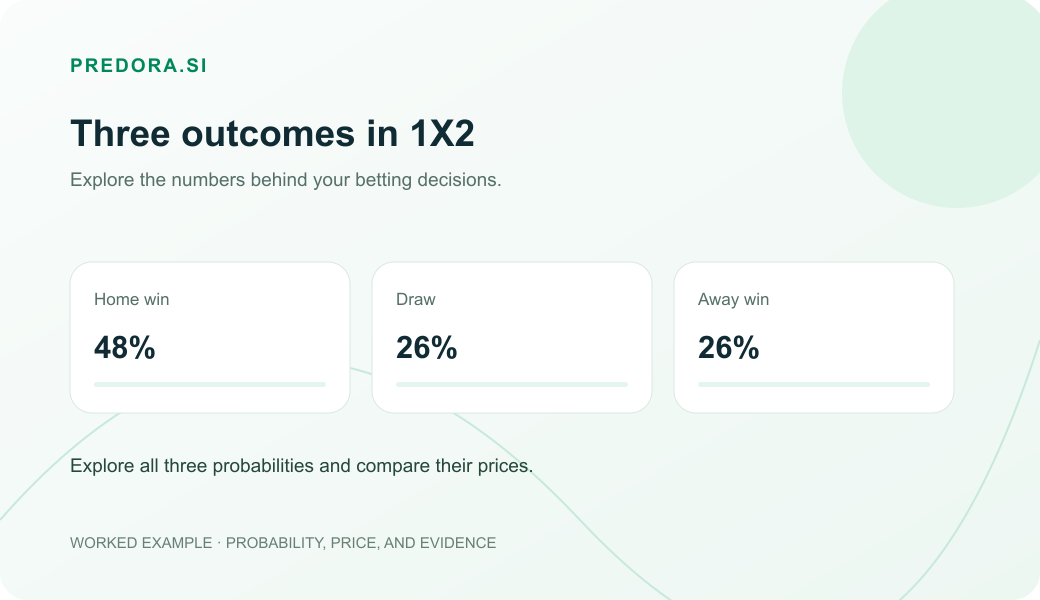
The three outcomes make 1X2 easy to understand. The analytical opportunity comes from comparing each price with its estimated probability.
Does 1x2 apply to extra time and penalties?
In the standard football reading, the 1x2 market considers the result at the end of regular time, including stoppage time. In other words: it usually does not include extra time or a penalty shootout.
In Copa do Brasil, Libertadores, Sudamericana, or any knockout match, this is very important. If a match ends 1-1 in 90 minutes and the home team wins on penalties, the standard 1x2 result was X, not a home win.
In 1x2, think of the score at the end of 90 minutes plus stoppage time, unless the bookmaker makes a different rule very clear.
Market, selection, and odds: don't mix everything up
Before moving on, it's worth separating three concepts that many people mix up:
| Concept | What is | Example |
|---|---|---|
| Market | The bet type | 1x2 |
| Selection | The choice within the market | 1, X or 2 |
| Odds | The price paid by the bookmaker | 2.10 for home win |
In 1x2, there is usually no numerical line like in Over 2.5 goals. Here the question is the final result: home win, draw, or away win. Odds are not synonymous with value. Odds are price. Value appears when that price is good relative to probability.
Main 1x2 formulas
To move beyond intuitive opinion, translate the odds into probability, compare with the estimated probability, and see whether the price is worth it.
Implied probability = 1 ÷ decimal oddsFair odds = 1 ÷ estimated probabilityEdge = model probability − implied probabilityEV = (estimated probability × odds) − 1How to calculate implied probability in 1x2
A implied probability is the chance embedded in the bookmaker's odds. Odds of 2.00 price that outcome as if it had approximately 50% probability.
Implied probability = 1 ÷ decimal odds 1 ÷ 2.00 = 0.50 = 50%| Outcome | Odds | Approximate implied probability |
|---|---|---|
| Home team wins | 2.10 | 47,6% |
| Draw | 3.40 | 29,4% |
| Away team wins | 3.80 | 26,3% |
The sum gives 103.3%. That excess above 100% is the bookmaker's margin, the built-in fat in the odds.
How to calculate fair odds and EV in 1x2
A fair odds is the odds consistent with the estimated probability, without considering the bookmaker's margin. If a model estimates 52% probability for the home team to win, the fair odds would be 1.92.
Fair odds = 1 ÷ 0.52 = 1.92 EV = (0.52 × 2.10) − 1 = +9.2%If the bookmaker pays 1.75, the odds are below fair. If it pays 1.92, it's close to the fair price. If it pays 2.10, there may be value, because it's paying above the estimated fair odds.
Under this estimated probability, the offered odds exceed the fair price. Explore the match factors to assess the opportunity.
Complete football example
Imagine a Série A match: Home FC x Away EC. The bookmaker offers these odds for the 1x2 market:
| Outcome | Bookmaker odd | Implied probability |
|---|---|---|
| 1 - Home win | 2.10 | 47,6% |
| X - Draw | 3.40 | 29,4% |
| 2 - Away win | 3.80 | 26,3% |
Now imagine the Active Model estimates:
| Outcome | Model probability | Fair odds | Reading |
|---|---|---|---|
| 1 - Home win | 52% | 1.92 | Bookmaker pays above fair. |
| X - Draw | 27% | 3.70 | Bookmaker pays below fair. |
| 2 - Away win | 21% | 4.76 | Bookmaker pays below fair. |
In this scenario, the data is more consistent with the home team, not only because it has a higher probability, but because the odds are above the estimated fair odds. That's the difference between selection and price analysis.
How to analyze the 1x2 market step by step
1. Understand which result you are evaluating
In 1x2, you evaluate a specific selection: 1, X, or 2.
2. Convert the odds into implied probability
To contextualize the odds, translate the price into probability with 1 ÷ odd.
3. Compare with the estimated probability
If the model sees 46% and the bookmaker prices 40%, there may be an edge.
4. Calculate the fair odds
Fair odds make it clear what price would make sense for the estimated probability.
5. Calculate the EV
EV turns the difference between price and probability into mathematical expectation.
6. Compare the game factors
Check PPG, wins, draws, goal difference, xG, recent form, and home advantage.
7. Compare odds between bookmakers
Odds of 2.15, instead of 2.02, improve the EV if the analysis is the same.
8. Consolidate the reading with a method
The reading gains consistency when price, probability, and context are clear.
Which factors weigh most in the 1x2 market?
1x2 is a result market. Therefore, it tends to depend more on relative strength, consistency, and matchup context.
| Factor | Why it matters | Point of attention |
|---|---|---|
| PPG | Measures consistency in points per game. | Compare the home team at home vs. the away team away. |
| Win % | Helps measure the real ability to win. | Overall win rate can hide a drop in away matches. |
| % of draws | Helps avoid ignoring X in balanced matches. | Draws are often underestimated by emotional bettors. |
| Goal difference | Shows dominance or vulnerability. | May be distorted by blowout results outside the curve. |
| xG difference | Helps measure the quality of chances. | xG is not a score; it's a performance signal. |
| Home vs away | Many teams change a lot depending on home or away status. | Don't compare only overall averages. |
In 1x2, the reading gains strength when probability, price, and factors tell a similar story.
How do different scenarios appear in 1x2?
Favorite with still interesting odds
Sometimes the home team is the favorite, but the bookmaker still pays above the estimated fair odds. Favoritism only matters if the price is worth it.
Underestimated away team
Some away teams have good away PPG, while the home team fluctuates at home. The 2 can have value even without being a popular selection.
Draw with relevant probability
Balanced matches, with close goal difference and xG, can give strength to X when the odds are paying above the estimated probability.
Odds above fair
The central situation is simple: if the bookmaker pays more than the model's fair odds, there may be value in that result.
1x2 vs Double Chance: what's the difference?
| Point | 1x2 | Double Chance |
|---|---|---|
| What it covers | A specific result. | Two outcomes. |
| Example | 1 = home team wins. | 1X = home team wins or draws. |
| Risk | Higher. | Lower. |
| Odds | Generally higher. | Generally lower. |
| Common use | When there is clear value in one result. | When there is strength on one side, but draw risk. |
Double Chance reduces risk, but also reduces the odds. So the question remains the same: is the price worth it?
Does high probability in 1x2 always imply positive EV?
No. A result can have high probability and still be a bad bet if the odds are too low.
| Scenario | Model probability | Fair odds | Bookmaker odd | Reading |
|---|---|---|---|---|
| Home favorite | 70% | 1.43 | 1.30 | High probability, bad price. |
| Competitive away team | 45% | 2.22 | 2.60 | Lower probability, better price. |
Probability helps understand chance. EV helps understand whether the price is worth it.
How to interpret 1x2 in the long run
Football has variance. A team can dominate, create more, have better xG, hit the woodwork twice, and still draw. That's why 1x2 analysis should not be judged by a single match.
- Odds above the fair price indicate a more favorable value relationship.
- Separate the statistical reading from emotional reactions.
- Compare bookmakers.
- Respect the statistical base and league sample.
- Compare Accuracy, Return, and the model's history.
- Understand that positive EV can lose in the short term.
How to apply this analysis on Predora.si
On Predora.si, the 1x2 market does not appear as a standalone odd. It fits into a more complete match reading.
| Area | How it helps with 1x2 |
|---|---|
| Upcoming Matches | Shows matches, league, Active Model probability, EV, best odds, and selection in the selected market. |
| Upcoming Games with EV+ | Helps find selections where the model sees a difference between estimated probability and the bookmaker's price. |
| Upcoming Games with High Probability | Helps look at higher-probability selections, without forgetting that EV still matters. |
| Odds Comparison | Shows which bookmaker is paying the most for each 1x2 result. |
| AI + Statistics | Helps assess whether PPG, wins, draws, goal difference, xG, form, and home advantage match the model's reading. |
| Performance | Helps understand in which leagues and samples the Active Model performs better. |
On Predora.si, you can see probability, EV, best odds, and statistical factors per match, using the Active Model to compare the bookmaker's price with an estimated probability.
Common mistakes when analyzing 1x2
1. Assuming the favorite is always value
The favorite may have a higher chance of winning, but the odds may be too low.
2. Ignoring the draw
In 1x2, the draw is a real outcome and can distort the entire reading if ignored.
3. Comparing odds from different markets
Odds of 1.80 in 1x2 are not the same as odds of 1.80 in Over 2.5 or Both Teams to Score.
4. Only looking at the table
Position helps, but it doesn't replace home/away form, attacking output, recent form, and price.
5. Confusing the best odds with positive EV
The best odds are simply the highest quote among bookmakers. EV also depends on the estimated probability.
6. Forgetting the bookmaker margin
In 1x2, the sum of implied probabilities usually exceeds 100%.
7. Changing strategy because of a single result
Losing a bet with positive EV is part of the game. The problem is abandoning the method on impulse.
Practical checklist for analyzing 1x2
- Identify the selection being analyzed: 1, X or 2.
- Check the best available odds for that selection.
- Convert the odds into implied probability.
- Compare with the Active Model's probability.
- Calculate the fair odd.
- See whether the EV is positive or negative.
- Compare the factors of the Result market.
- Compare the home team at home vs. the away team away.
- Check whether the league/model base is reliable.
- Reassess the EV if the odds have worsened or the factors are highly conflicting.
FAQ about the 1x2 market
What does 1x2 mean in football?
1x2 is the final result market. 1 means home win, X means draw, and 2 means away win.
Does the 1x2 market include extra time and penalties?
Under the standard rule, no. 1x2 considers the result at the end of 90 minutes plus stoppage time. In knockout matches, extra time and penalties are usually not included in standard 1x2.
Is 1x2 better than Double Chance?
There is no absolute better option. 1x2 usually pays more because it covers only one outcome. Double Chance covers two outcomes and usually has lower odds. The comparison depends on probability and price.
Does high probability in 1x2 imply positive EV?
Not necessarily. A selection can have a high chance of happening and still have negative EV if the odds are too low.
How do I know if a 1x2 odds has value?
Compare the estimated probability with the implied probability of the odds. If the model estimates a higher chance than the bookmaker is pricing in, and the EV is positive, there may be value.
How does Predora.si help with the 1x2 market?
Predora.si shows probability, EV, best odds, bookmaker comparison, Active Model, and statistical factors for the 1x2 market.
Closing
In 1x2, correctly estimating the winner is not enough. The analysis also needs to consider the price relative to the risk. The most solid path is to compare the market, measure probability, calculate EV, compare factors, and respect variance.
Predora connects model probabilities, bookmaker prices, and match context so you can investigate potential value with the evidence in view.