Direct answer
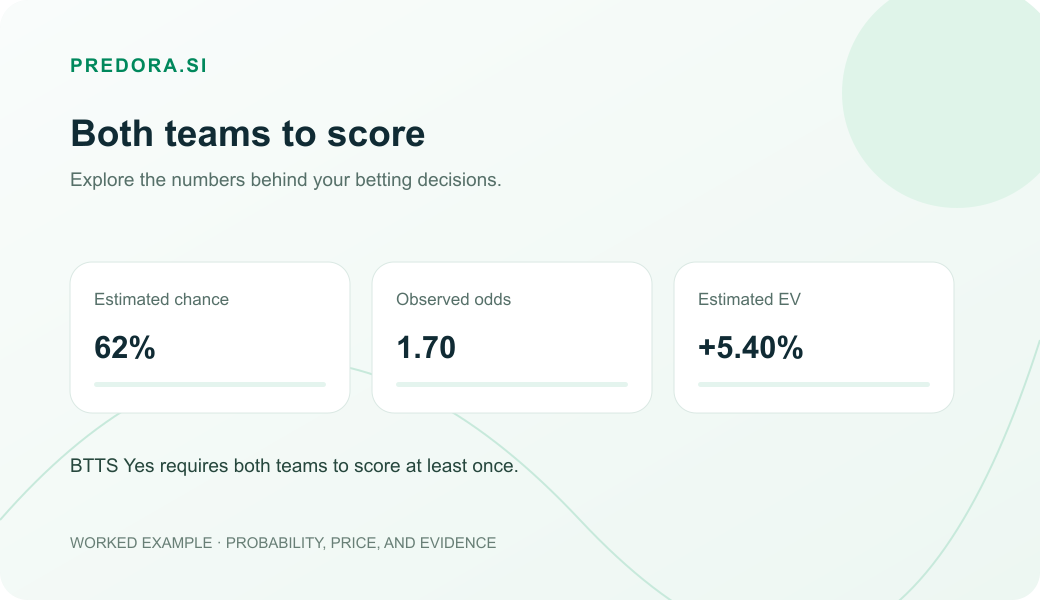
BTTS, or Both teams to score, it is the market in which you assess whether both teams have a real path to scoring at least one goal in the game. The analysis should not only look at whether the match seems open. The ideal is to cross-reference offensive output, goals conceded, clean sheets, failure to score, odds, estimated probability, and EV.
Definition in one sentence: BTTS / Both Teams to Score is the football market in which the bet depends on both teams scoring at least one goal, regardless of who wins the match.
Quick summary
| Point | How to think about it |
|---|---|
| Definition | BTTS stands for Both Teams To Score, meaning both teams to score. |
| Central question | Do both teams have a real argument to score at least 1 goal? |
| BTTS Yes | It wins when both teams score: 1x1, 2x1, 2x2, 3x1, etc. |
| BTTS No | Wins when at least one team keeps a clean sheet: 0x0, 1x0, 2x0, 0x3, etc. |
| Strong factors | Goals scored, goals conceded, shots on target, offensive creation, failure to score, clean sheets, and recent form. |
| Common mistake | Confusing BTTS with Over 2.5 goals. A 1-1 scoreline hits BTTS but does not hit Over 2.5. A 3-0 scoreline hits Over 2.5 but does not hit BTTS. |
| Predora.si | The app allows you to filter the Both Teams to Score market, see chance, EV, best odds, compare odds, and contextualize the reading with AI + Stats. |
What is BTTS / Both Teams to Score?
BTTS stands for Both Teams To Score. In practice, the question is straightforward:
Will both teams score at least one goal?
You do not need to get the score right. You do not need to get the winner right. You need to assess whether there is a plausible scenario in which both home and away teams find the back of the net.
Simple result examples
| Final score | BTTS Yes | BTTS No | Why |
|---|---|---|---|
| 0x0 | No | Yes | Nobody scored. |
| 1x0 | No | Yes | Only one team scored. |
| 2x0 | No | Yes | Only one team scored. |
| 1x1 | Yes | No | Both teams scored. |
| 2x1 | Yes | No | Both teams scored. |
| 3x2 | Yes | No | Both teams scored. |
| 3x0 | No | Yes | There were plenty of goals, but only from one side. |
In general, this market considers regular time, including stoppage time, and not extra time. Still, it is always worth checking the rule applicable to the market being analyzed.
Why is BTTS different from betting on many goals?
BTTS and Over 2.5 goals are closely related, but they are not the same thing. Over 2.5 asks whether the game will have 3 or more goals in total. BTTS asks whether both teams will score, even if the total number of goals is low.
| Scenario | Over 2.5 goals | BTTS Yes | Reading |
|---|---|---|---|
| 1x1 | No | Yes | Both teams scored, but only 2 goals were scored. |
| 2x1 | Yes | Yes | Over and BTTS both hit. |
| 3x0 | Yes | No | There were 3 goals, but only one team scored. |
| 0x0 | No | No | Game locked for both markets. |
| 4x1 | Yes | Yes | Open game with goals from both sides. |
This difference is important because there are games that look like Over but do not have as much strength for BTTS. And there are games where the most likely scoreline seems to be 1-1, which aligns better with Both Teams to Score than with Over 2.5.
The main logic of BTTS
For the data to support BTTS Yes, two conditions need to appear at the same time:
- Team A has a real path to scoring.
- Team B also has a real path to scoring.
It is not enough for one team to be offensive. It is not enough for the game to look good. BTTS requires a double condition.
Signs that help
- Both teams score frequently.
- Both teams concede goals frequently.
- There is enough offensive creation from both sides.
- The home and away context does not drag down one of the attacks too much.
Factors that weaken the BTTS case
- A team goes many games without scoring.
- A defense keeps clean sheets frequently.
- The odds are too low for the estimated probability.
- The recent sample is small or heavily distorted.
In plain terms: the data becomes more compatible with BTTS when both sides have enough attack to score and a defense vulnerable enough to concede.
How to know if the BTTS odds are paying well
Statistical analysis helps understand whether the scenario looks like Both Teams to Score. But the value reading depends on the odds.
Implied probability = 1 ÷ decimal oddsFair odds = 1 ÷ estimated probabilityEV = (estimated probability × odds) − 1Edge = estimated probability − implied probabilityQuick example
Imagine a Série A game with an estimated probability of 56% for BTTS Yes and best available odds of 1.95.
Implied probability = 1 ÷ 1.95 Implied probability = 51.3% Fair odds = 1 ÷ 0.56 Fair odds = 1.79 EV = (0.56 × 1.95) − 1 EV = +9.2% Edge = 56% − 51.3% Edge = +4.7 p.p.At an estimated 56% probability, fair odds are about 1.79. Odds of 1.95 therefore produce positive EV under that estimate. Explore both teams’ attacking and defensive factors to evaluate the opportunity.
Which factors matter most when analyzing BTTS?
BTTS has a particularity: you need to analyze the attack and defense of both sides. The best approach is to split the analysis into four questions.
1. Do both teams usually score?
Look at goals scored per game, games with 1+ goal scored, shots on target, attacking creation, xG or xG proxy, and recent form.
2. Do both teams usually concede?
Assess goals conceded, games with 1+ goal conceded, clean sheets, shots on target conceded, xG against, and recent defensive form.
3. Does one team frequently fail to score?
Failure to score can break BTTS on its own, even when the opponent usually concedes goals.
4. Does any team keep many clean sheets?
A high clean sheet rate weakens the BTTS case, especially against an attack that creates few chances.
Reading table of the main signs
| Signal | Strengthens BTTS Yes when... | Weakens BTTS Yes when... |
|---|---|---|
| Goals scored | Both teams score frequently. | One of the teams has low attacking output. |
| Goals conceded | Both sides concede goals frequently. | A defense concedes little and controls the game well. |
| Shots on target | Both sides arrive with real danger. | One side finishes little or barely hits the target. |
| Fails to score | Both teams rarely keep a clean sheet. | A team goes many games without scoring. |
| Clean sheets | Both defenses struggle to keep clean sheets. | One team keeps many games without conceding. |
| Recent form | Both attacks are alive in recent games. | An attack has dropped off or a defense has improved significantly. |
| Home/away | Home team at home and away team away maintain their attacking pattern. | Away team drops off significantly away or home team locks games down at home. |
| H2H | Recent head-to-heads reinforce the pattern, with a reasonable sample. | Few games or outdated context distort the reading. |
Which signs strengthen the BTTS Yes reading?
The data tends to be more compatible with BTTS Yes when the game combines attacking output from both sides with defensive vulnerability from both sides.
- Home team scores well at home.
- Away team also manages to score away.
- Home team concedes goals frequently.
- Away team concedes goals frequently.
- Clean sheet rates for both sides are not high.
- Failure to score rates for both sides are not extreme.
- Shots on target and creation confirm real danger.
- Odds are above the estimated fair odds.
Reading example
| Factor | Home | Away | Reading |
|---|---|---|---|
| Goals scored | 1.7 | 1.3 | Both have attacking output. |
| Goals conceded | 1.2 | 1.5 | Both defenses give up space. |
| 1+ goal scored | 82% | 74% | Good sign for both sides. |
| 1+ goal conceded | 68% | 76% | Defensive vulnerability shows up. |
| Clean sheets | 22% | 18% | Little evidence against BTTS from this factor. |
This scenario shows signs compatible with BTTS Yes. Still, the value reading depends on the odds being above the estimated fair price.
Which signs strengthen the BTTS No reading?
BTTS No is not just about a bad game. The data can be compatible with it in games with strong favoritism, dominant defense, or a very weak attack on one side.
Good scenario for BTTS No
- One team frequently fails to score.
- One team has many clean sheets.
- The favorite has a profile of winning without conceding.
- The underdog creates little away from home.
- The market is paying too little for BTTS Yes.
Scorelines with this profile
- 2x0: dominant favorite and strong defense.
- 0x0 or 1x0: locked game and little creation.
- 1x0: the home team holds up well at home.
- 2x0: away team has little path to scoring.
BTTS in Brazilian football: what changes in practice?
In Brazilian football, the BTTS reading needs to respect context a lot. Brasileirão, Série B, Copa do Brasil, Libertadores, and state championships can have very different dynamics.
Home advantage weighs heavily
Some teams improve a lot at home and drop off significantly away.
Série B can be more congested
Depending on the round, BTTS Yes may need a better price to compensate.
Copa do Brasil changes with the aggregate
In knockout ties, behavior can deviate significantly from the season pattern.
Compare state leagues within their own context
Few games and a large technical gap can distort averages.
Libertadores has strong context
Travel, altitude, pitch, intensity, and home advantage can change the game profile.
That is why BTTS should not be read only by overall average. The ideal is to look at home/away splits, season, last 5 games, league average, and sample.
How to interpret BTTS in the long run
BTTS gives you a clear question: can both teams score? Explore chance creation, defensive records, and lineup context to build a fuller picture of each side.
The isolated result does not summarize the reading; the relationship between odds and estimated probability describes the EV of the scenario.
In the long run, what matters is repeating assessments with a good relationship between probability, odds, and EV.
How to apply this analysis on Predora.si
On Predora.si, the market Both teams to score changes the analysis lens. When you select this market, chance, EV, selection, odds comparison, and factors all answer the question:
Does this game have the profile for both teams to score?
Practical flow on Predora
- Open Upcoming Games.
- Select the Both Teams to Score market.
- Check the estimated probability from the Active Model.
- Check the expected value (EV).
- Compare the best available odds.
- Open the game to see more context.
- Use AI + Stats to review potential BTTS, clean sheets, failure to score, recent games, H2H, league average, and sample.
- Upcoming Games with EV+ organizes comparisons between price and probability.
- AI Radar organizes games by simulated historical performance slices.
Where each area helps
| Predora area | How it helps with BTTS |
|---|---|
| Upcoming Matches | Shows the broad menu of games in the Both Teams to Score market. |
| Upcoming Games with EV+ | Organizes scenarios with positive EV in the selected market. |
| Upcoming Games with High Probability | Shows games with higher probability, remembering that high chance does not mean value. |
| AI Radar | Organizes games by simulated historical performance slices from the Active Model. |
| Performance | Compares the Active Model across leagues with Base, Hit Rate, and Return. |
| AI + Statistics | Provides transparency to review the prediction with market-specific factors. |
Open Predora.si, select the Both Teams to Score market, and compare chance, EV, and best odds to interpret the market.
BTTS and Custom Models
In Custom Models, the Both Teams to Score (BTTS) block is used to adjust the reading of this market without mixing everything with result, over, or corners.
| Custom model | Idea | Evidence to examine |
|---|---|---|
| Aggressive BTTS | More weight for attack, goals conceded, and creation from both sides. | Can increase exposure to overly open games and already squeezed odds. |
| Conservative BTTS | Give more weight to failure to score and clean sheets. | Can classify as weak games with statistically interesting prices. |
| Home/away BTTS | Value the home team at home and the away team away. | You must respect the sample and league context. |
| Recent form BTTS | Pay more attention to the form of attacks and defenses. | Last 5 games help, but they can fluctuate a lot. |
Common mistakes when betting on BTTS
1. Confusing BTTS with Over 2.5
A 3x0 has many goals, but it does not hit BTTS. A 1x1 hits BTTS, but it does not hit Over 2.5.
2. Looking only at total goal average
Total average can hide 3x0 or 0x3 games, which do not necessarily indicate Both Teams to Score.
3. Ignoring failure to score
If a team goes blank for many games, BTTS Yes becomes dangerous.
4. Ignoring clean sheets
A high clean sheet rate can bring down the BTTS Yes reading, especially against a weak attack.
5. Betting just because the odds seem high
High odds do not automatically mean value. They need to be above the estimated fair price.
6. Trusting H2H too much
Teams change managers, squads, style, form, and context. H2H should be a complement.
7. Reading EV without checking match factors
Positive EV compares price with estimated probability. Match factors help you examine the estimate.
Practical checklist for analyzing BTTS
- Do both teams score frequently?
- Do both teams concede goals frequently?
- Does the home team maintain good production at home?
- Can the away team score on the road?
- Does either team frequently fail to score?
- Does either team have a high clean sheet rate?
- Do shots on target and creation converge with the reading or diverge from it?
- Does recent form reinforce or contradict the season?
- What is the sample size of the data?
- Are the odds above the estimated fair odds?
- What is the calculated EV for the observed odds?
- Did the odds comparison show the best available price?
Quick reading matrix
| Scenario | Likely reading | Analytical reading |
|---|---|---|
| Two strong attacks + two vulnerable defenses + odds above fair value | Greater statistical compatibility with BTTS Yes. | EV and final context complete the assessment. |
| A strong attack + another very weak one | Fragile BTTS Yes. | The data may be more compatible with BTTS No or another market. |
| Game with a 3-0 feel | The data aligns more with total goals than with both teams' participation. | Comparing with Over 2.5 helps separate total goals from both teams' participation. |
| Both teams score, but the odds are very low | The chance may be high, the value may be low. | EV shows how the price changes the estimated value. |
| Small sample | Unstable statistics. | The evidence serves as support, with limited weight. |
How BTTS relates to value betting
A BTTS bet only becomes a value bet when the odds pay more than they should for the estimated probability.
High chance, poor price
Estimated probability: 60%
Fair odds: 1.67
Bookmaker paying: 1.55
Even with a high chance, the price may not be worth it.
Lower chance, better price
Estimated probability: 52%
Fair odds: 1.92
Bookmaker paying: 2.10
Here the chance is lower, but the price may be more interesting.
FAQ about BTTS / Both teams to score
What does BTTS mean in football betting?
BTTS stands for Both Teams To Score. It is the market where you bet on whether both teams will score at least one goal in the match.
Which scorelines make BTTS Yes win?
BTTS Yes wins on scorelines like 1-1, 2-1, 1-2, 2-2, 3-1 and 3-2, because both teams scored. It loses on scorelines like 0-0, 1-0, 2-0 or 0-3.
Is BTTS the same as Over 2.5 goals?
No. BTTS looks at whether both teams scored. Over 2.5 looks at whether the game had three or more goals. A 1-1 hits BTTS, but does not hit Over 2.5. A 3-0 hits Over 2.5, but does not hit BTTS.
Which statistics matter most for BTTS?
The main ones are goals scored, goals conceded, shots on target, attacking creation, failure to score, clean sheets, recent form, and the home/away split.
Does a high probability in BTTS Yes imply positive EV?
Not necessarily. EV depends on the estimated probability and the odds. A high probability combined with low odds can produce negative EV.
Can BTTS No also have value?
Yes. BTTS No can have value when a team frequently fails to score, when a defense keeps many clean sheets, or when the market is overestimating the chance of both teams scoring.
How does Predora.si help analyze BTTS?
Predora.si lets you filter games by the Both Teams To Score market, compare odds across bookmakers, see the estimated probability from the Active Model, calculate EV, and contextualize the reading with AI + Statistics factors.
Conclusion
BTTS analysis brings both attacks and defenses into focus: who creates chances, who concedes, and how the odds compare with the probability of both teams scoring.
Predora.si helps in this process by combining the Active Model, best available odds, expected value, and Both Teams To Score market factors to make the reading less dependent on guesswork and more method-driven.