Direct answer
Odds is the price of a bet: it shows how much the bookmaker pays if the selection wins. In decimal format, odds of 2.00 mean that each $1 bet returns $2 in total, already including the stake.
The higher the odds, the higher the potential return and, in general, the lower the implied chance. But the key point is this: odds are not a selection. Odds are a price.
Quick summary
| Term | Odds. |
|---|---|
| Category | Odds and probability. |
| One-sentence definition | Odds are the price the bookmaker pays for a winning bet. |
| Also called | Quote. |
| Most common format in Brazil | Decimal odds, such as 1.80, 2.00, or 2.50. |
| Return formula | Total return = stake × odds |
| Probability formula | Implied probability = 1 ÷ decimal odds |
| Common mistake | Thinking that a high odd implies positive EV. |
| How Predora.si helps | Shows odds by bookmaker, best available odd, model probability, fair odd, and EV per market. |
An odd is the price that represents the cost of a bet: it defines the total return of a winning bet and allows you to convert that price into implied probability.
How does an odd work?
The odd works as the price offered by the bookmaker for an outcome. When you look at a football market, such as Home team wins, Draw, Over 2.5 goals or Both Teams to Score, the odd shows how much you receive if that scenario happens.
In Brazil, the most common format is the decimal odds.
| Decimal odds | Common reading |
|---|---|
| 1.50 | Lower return, usually associated with a more likely scenario. |
| 2.00 | Doubles the stake in the total return. |
| 3.50 | Higher return, usually associated with a less likely scenario. |
A bet only starts to get interesting when you compare that price with the estimated probability of that outcome. That is where concepts like implied probability, fair odds, edge and positive EV.
Main formulas
Total return = stake x decimal oddProfit = total return - stakeImplied probability = 1 ÷ decimal oddsImplied probability (%) = (1 ÷ decimal odd) x 100Simple example
Odds = 2.00 1 ÷ 2.00 = 0.50 0.50 x 100 = 50%In other words: an odd of 2.00 suggests an implied probability of approximately 50%. That does not mean the real chance is exactly 50%; it means that is the price embedded in the odds.
Example in football
Imagine a Brasileirão match with this market 1x2:
| Outcome | Odds | Implied probability |
|---|---|---|
| Home team wins | 2.30 | 43,5% |
| Draw | 3.20 | 31,3% |
| Away team wins | 3.10 | 32,3% |
If you bet $100 on Home team wins at odd 2.30 and the bet wins:
Total return = 100 x 2.30 = $230 Profit = $230 - $100 = $130 Implied probability = 1 ÷ 2.30 = 0.4348 Implied probability ≈ 43.5%The good question is not just "does this odd pay well?". The good question is:
Is the estimated real chance higher than 43.5%?
If your model estimates 50% chance for the home team, this odd may be paying above the fair price. Then there may be value. If the model estimates only 38%, the odd may look nice, but it might not be worth it.
Odd, price, market, and line
| Term | What it means | Example |
|---|---|---|
| Odds | Price of the bet. | 2.10. |
| Price | Synonym for odd in Brazil. | "The price is 2.10". |
| Market | Bet type. | 1x2, Double Chance, Both teams to score. |
| Line | Number that defines some markets. | Over 2.5 goals, Over 9.5 corners. |
| Implied probability | Chance embedded in the odd. | Odds 2.00 = 50%. |
| Fair odds | Odd consistent with an estimated probability. | 50% chance = fair odd 2.00. |
Practical phrase: market is the question, line is the number, odd is the price. In Over 2.5 goals, for example, the market is goals, the line is 2.5, and the odd is the price the bookmaker offers for that scenario.
How the odd appears on Predora.si
On Predora.si, the odd always appears within a context: game, market, bookmaker and model probability.
1. Upcoming Matches
The page brings together matches, markets, and prices for comparison.
2. Upcoming Matches with EV+
The app organizes readings in which the odd and the estimated probability indicate positive EV.
3. Upcoming Matches with High Probability
You see matches with the highest estimated probability, without confusing high chance with good price.
4. Odds comparison
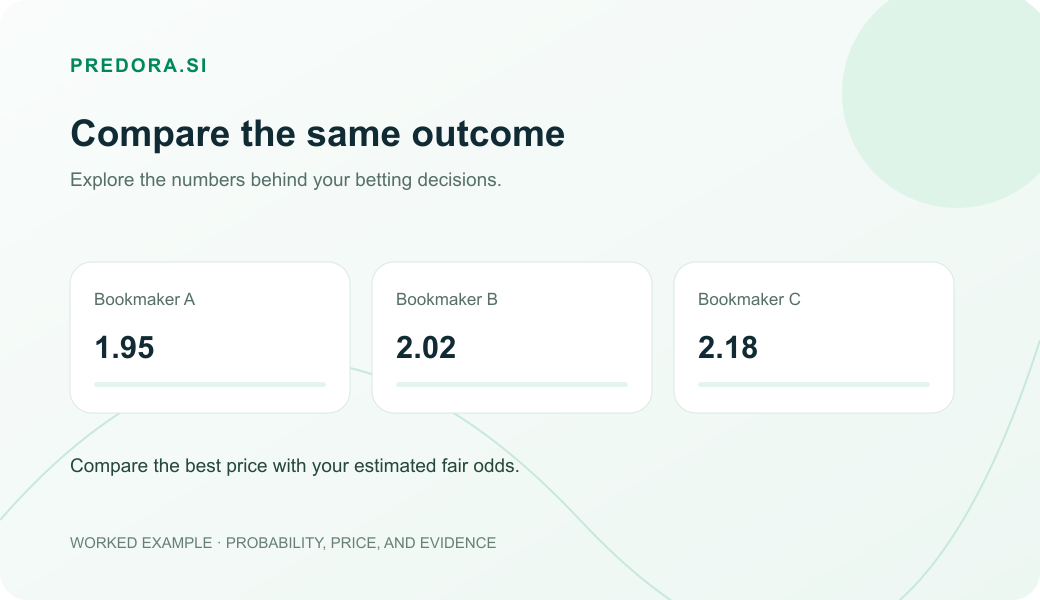
The same bet can pay differently across bookmakers, so the best available odds matter.
Predora crosses six points before a reading becomes useful:
- Bookmaker odd for the selected market.
- Best available odds among the monitored bookmakers.
- Active Model probability for that outcome.
- Fair odds calculated from the estimated chance.
- EV to measure whether the price has positive or negative expected value.
- Statistical match factors to contextualize the scenario before the decision.
How to interpret an odd the right way
1. As potential return
The higher the odds, the higher the return if the bet wins. $100 at odds 1.50 returns $150; $100 at odds 2.50 returns $250.
2. As implied probability
The higher the odd, the lower the implied probability. Odd 1.50 indicates 66.7%; odd 2.50 indicates 40%.
3. As a price to compare
If the bookmaker offers odd 2.50, it prices the scenario near 40%. If the model estimates 48%, there may be an estimated difference.
Common mistakes when interpreting odds
1. Thinking that a high odd is always better
A high odd pays more, but it usually represents a less likely scenario. It is only interesting if it is too high relative to the estimated probability.
2. Thinking that a low odd is a risk-free bet
A low odd may indicate a higher probability, but football has red cards, penalties, injuries, set pieces, and tight games.
3. Comparing different markets as if they were the same
Odd 1.80 on Over 2.5 goals is not the same as odd 1.80 on Home team wins. They are different questions.
4. Forgetting that the decimal odd includes the stake
If you bet $100 at odds 2.00, the total return is $200, but the profit is $100. The stake is already included in the return.
5. Confusing the best odds with positive EV
Best odd is just the best available price. To know if the bet is good, compare it with probability, fair odd, and EV.
Practical checklist for analyzing an odd
- Confirm the market: 1x2, Double Chance, Over 2.5 goals, Both Teams to Score or Over 9.5 corners.
- Check that the line is the same: Over 2.5 should not be compared with Over 3.5.
- Compare the odd across bookmakers to find the best available odd.
- Convert the odd into implied probability using
1 ÷ odd. - Compare with the estimated probability using your model or the Predora reading.
- Check whether there is positive EV to contextualize the price difference.
- Compare the context of the game with factors, market, recent form, and statistics.
- Remember that odds change and how positive EV connects an estimated probability with an offered price.
Use the Odds Converter to understand price formats, then convert the odd into probability and compare it with a chance estimate.
Quick questions about odds
Is an odd the same as a price?
Yes. In Brazil, many people use price as a synonym for odds. Both terms refer to the price paid by the bookmaker if the bet wins.
Do odds of 2.00 mean a 50% chance?
Odd 2.00 has an implied probability of 50%, because 1 ÷ 2.00 = 0.50. But that does not mean the event has exactly a 50% real chance.
Is a high odd better?
Not necessarily. A high odd pays more, but it also tends to indicate a lower probability. It is only better when it pays above the estimated fair price for that chance.
Why does the odd change?
Odds can change due to betting volume, bookmaker adjustments, news, lineups, injuries, market context, and price movement. A discrepancy can appear or disappear quickly.
Does Predora.si set the odds?
No. Predora.si is not a bookmaker. It compares odds from monitored bookmakers and crosses those prices with probability, fair odd, EV, and statistics for a more structured reading.
Next steps
The odd is the beginning of the analysis, not the end. Turn the price into implied probability, compare it with an estimated chance, and only then assess whether the price may have value.
In the app, open Upcoming Matches to see odds by market along with Active Model probability, EV, best available odd, and match factors.