Direct answer
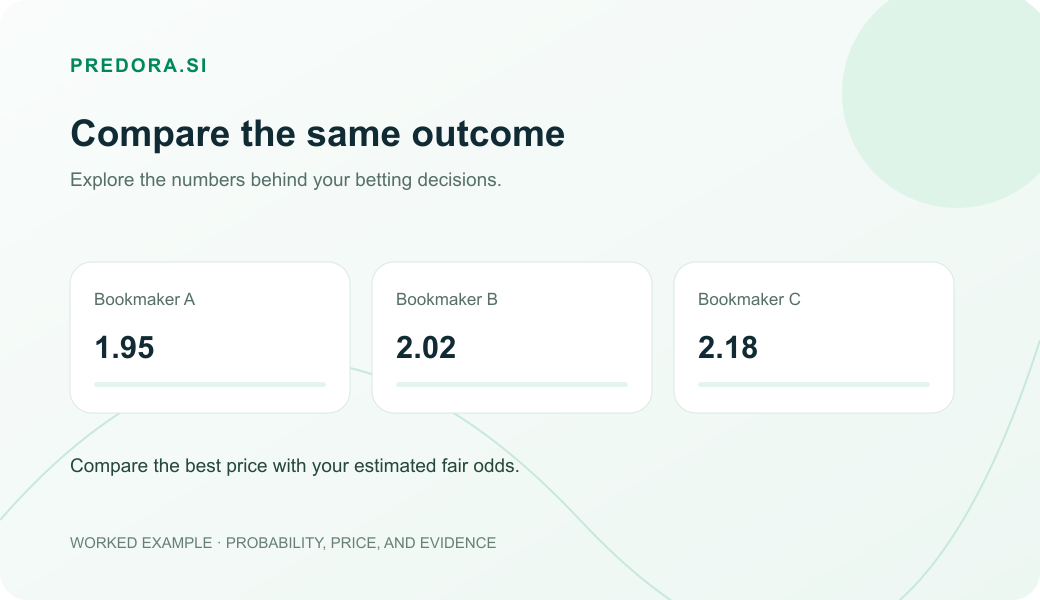
Best odds is the highest odds available among bookmakers for a specific bet, considering the same match, market, line, and selection. It improves the price you receive if the selection wins, but it doesn't automatically make the bet good.
Best odds gain context when compared against the estimated probability, a fair odds and the EV.
Quick summary
| Term | Best odds. |
|---|---|
| Also appears as | Best odds, best price, highest available odds. |
| Category | Odds and probability. |
| One-sentence definition | It is the highest odds found for the same bet among the compared bookmakers. |
| Practical formula | Best odds = max(comparable odds) |
| When to use | Compare observed prices in the same market and on the same line. |
| Common mistake | Thinking best odds implies positive EV. |
| How Predora.si helps | Highlights the best available odds and uses that price in EV calculations. |
Best odds are the highest price available for the same match, market, line, and selection. They improve the bet's price, but only have value when above the estimated fair price.
How do best odds work?
Think of the odd as the bet price. If two bookmakers offer different odds for the same selection, the best odds are simply the highest one. In decimal odds, the higher the odds, the greater the total return if the bet wins.
The comparison only makes sense when you are looking at exactly the same thing:
- Same match: compare the same match.
- Same market: 1x2 with 1x2, Over with Over, BTTS with BTTS.
- Same line: Over 2.5 is not the same as Over 3.5.
- Same selection: home win, draw, away win, or the exact selection of that market.
Compare Flamengo wins in 1x2 with Flamengo or draw in Double Chance is not comparing best odds. These are different markets with different risks.
Formulas
Best odds = highest odds available for the same betImplied probability = 1 / best oddsEV = (estimated probability x best odds) - 1Fair odds = 1 / estimated probabilityBest odds are the price side. The decision becomes more complete when that price is compared with the estimated probability and fair odds.
Example in football
Imagine a Brasileirão game in the market 1x2, with the selection home team wins.
| Home | Odds for home win |
|---|---|
| Bookmaker A | 2.10 |
| Bookmaker B | 2.18 |
| Bookmaker C | 2.25 |
In this case, the best odds is 2.25, because it is the highest price available for the same selection.
| Odds | Total return on $100 | Net profit |
|---|---|---|
| 2.10 | $210 | $110 |
| 2.25 | $225 | $125 |
The difference seems small, but in the long run this kind of choice matters. You didn't change the match, the market, or your analysis. You just got a better price.
Now bringing it to EV, if the model estimates a 48% chance:
EV with odds 2.10 = (0.48 x 2.10) - 1 = +0.008 = +0.8% EV with odds 2.25 = (0.48 x 2.25) - 1 = +0.08 = +8.0%Same selection. Same probability. Different price. That's why best odds can change the reading of a bet on the edge into a bet with a clearer estimated difference.
Best odds are not synonymous with positive EV
Best odds only tell you which bookmaker is paying more. They don't tell you, on their own, whether the bet has value.
| Estimated probability | Fair odds | Best available odds | Reading |
|---|---|---|---|
| 40% | 2.50 | 2.30 | It is the best among bookmakers, but still below the fair price. |
| 40% | 2.50 | 2.70 | It is above fair odds and may indicate value. |
| Concept | What it means | Who defines |
|---|---|---|
| Best odds | Highest odds available among bookmakers for that bet. | Market and compared bookmakers. |
| Fair odds | Odds consistent with the estimated probability. | Model or analysis. |
| Value bet | When the offered odds are above fair odds. | Comparison between price and probability. |
How it appears on Predora.si
On Predora.si, best odds appear in the price comparison of the same market and the same line, bringing together observed prices in a single view.
1. Compares odds for the same match
The app organizes odds from different bookmakers within the same match, market, and selection context.
2. Highlights the best available odds
The comparison shows where the same selection has the highest observed price.
3. Cross-references price with Active Model
Best odds are combined with probability, fair odds, edge, EV, and match factors.
This care is especially useful in flows such as:
- Upcoming Matches: explore matches with chance, EV, market, and odds.
- Upcoming Games with EV+: find situations where best odds may be above the fair price.
- Upcoming Games with High Probability: remember that high chance with poor odds may not be worth it.
- Odds comparison: see who is paying more for each outcome.
When do best odds make the most difference?
positive EV
When the bet already has positive expected value, a better price increases the estimated difference.
Average or high odds
Small differences can significantly change the return and EV.
Repeated process
Comparing prices across many bets reduces the cost of accepting worse odds.
Moving market
If the odds drop, the positive divergence can disappear even if the initial reading remains the same.
Common mistakes
1. Comparing prices without checking probability
They don't. Best odds are just the highest available price. The bet still carries risk and variance.
2. Compare different markets
Odds of 1.85 on Over 2.5 goals are not better or worse than odds of 1.85 on 1x2. These are different questions.
3. Compare different lines
Over 2.5 and Over 3.5 are not the same bet. The line changes risk, probability, and fair price.
4. Ignoring fair odds
The best odds among bookmakers can still be below the estimated fair odds. In that case, the price remains below the estimate.
5. Ignoring a price change
When odds drop and EV is no longer positive, the price reading needs to be recalculated.
Practical checklist
- Am I comparing the same game?
- Am I in the same market?
- Is the line exactly the same?
- Is the selection the same? Home win, Over 2.5, or BTTS Yes, for example.
- Is this really the highest odds available?
- Are the odds above the estimated fair odds?
- Is EV still positive or interesting?
- Do the match factors not contradict the reading?
- Do the odds still match the price observed in the analysis?
Start by comparing the same bet across bookmakers. Then convert the best odds into implied probability and see whether the EV still makes sense.
FAQ about best odds
Is the best odds always the best bet?
No. Best odds are just the highest price available among bookmakers for the same bet. They only become interesting when they make sense against the estimated probability, fair odds, and EV.
Why is comparing odds important?
Because small price differences accumulate in the long run. If you always take worse odds than what's available, your potential return drops without your match analysis having changed.
Are best odds and fair odds the same thing?
No. Best odds comes from comparing bookmakers. Fair odds comes from the probability estimated by the model or your analysis. Value appears when best odds are above fair odds.
Can I compare odds from different markets?
Not the right way. To compare odds correctly, you need to look at the same match, the same market, the same line when there is one, and the same selection.
How does a drop in best odds change the analysis?
The implied probability, edge, and EV must be recalculated with the new odds. A sufficient drop can eliminate the positive divergence that existed at the previous price.
Next steps
Bring the best available price together with probability, EV, and match factors to evaluate the opportunity with a fuller picture.
On Predora.si, this process appears connected: you see Active Model probability, best available odds, EV, and match factors in the same analysis flow.