Direct answer
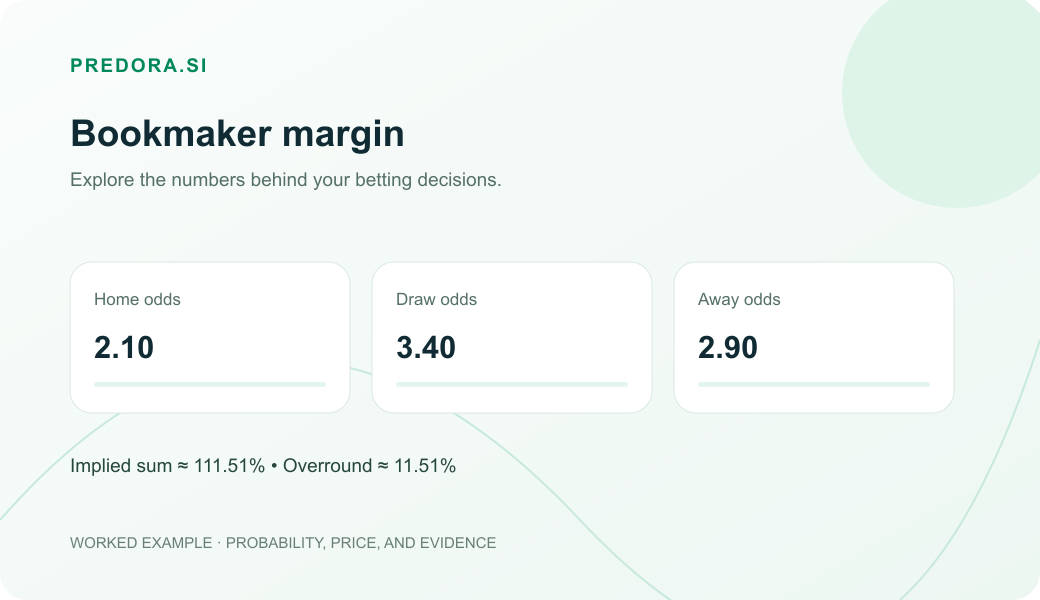
Bookmaker margin is the percentage built into the odds to give the bookmaker a statistical advantage in the long run. You notice this margin when you add up the implied probabilities of all outcomes in a market and the total exceeds 100%.
In one sentence: the bookmaker margin is the extra built into the odds that makes a market seem to add up to more than 100% probability.
Quick summary
| Term | Bookmaker margin. |
|---|---|
| Also called | Vig, juice, or overround. |
| Category | Odds and probability. |
| Formula | Margin = sum of implied probabilities - 100% |
| Where it appears clearly | Markets with all outcomes visible, such as 1x2. |
| Why it matters | Higher margins generally mean less favorable odds for the bettor. |
| Common mistake | Thinking that a lower margin already means a value bet. |
| How Predora.si helps | By comparing odds, best available odd, Active Model probability, edge, and EV. |
The bookmaker margin is the excess above 100% that appears when the odds of all outcomes in a market are converted into implied probability and added together.
How does the bookmaker margin work?
Every decimal odd carries an implied probability.
Implied probability = 1 / decimal oddImplied probability (%) = (1 / decimal odd) x 100If a market were fair and without margin, the sum of the implied probabilities of all outcomes should be close to 100%. In practice, the bookmaker adjusts the odds so that this sum stays above 100%. That excess is the margin.
In football, the simplest example is the 1x2market: home win, draw, or away win. To calculate the margin, you convert the three odds into implied probability and add everything up.
Bookmaker margin formula
Overround = probability of 1 + probability of X + probability of 2Bookmaker margin = overround - 100%1x2 margin = [(1 / odd 1) + (1 / odd X) + (1 / odd 2)] - 100%The calculation needs to consider all possible outcomes of that market. Looking at only one odd doesn't show the margin of the entire market.
Example in football
Imagine a Brasileirão game with these odds in the 1x2 market:
| Outcome | Odds | Implied probability |
|---|---|---|
| Home team wins | 2.10 | 47,62% |
| Draw | 3.30 | 30,30% |
| Away team wins | 3.60 | 27,78% |
47.62% + 30.30% + 27.78% = 105.70% Bookmaker margin = 105.70% - 100% Bookmaker margin = 5.70%In this example, the market is not priced as if exactly 100% of chance were distributed among home, draw, and away. It is priced with built-in fat of 5,70%.
Bookmaker margin, overround, vig, and juice
In practice, many people use these terms in a similar way.
| Term | How to understand |
|---|---|
| Overround | The total sum of the market's implied probabilities. Example: 105.70%. |
| Bookmaker margin | The excess above 100%. Example: 5.70%. |
| Vig / juice | English terms used to refer to the charge built into the price. |
If a market's overround is 105,70%, the bookmaker margin is 5,70%.
Why does the bookmaker margin matter?
Because it directly affects the price you are receiving. Higher margins usually mean worse odds for the bettor, and worse odds make it harder to find value in the long run.
Bookmaker with high margin
Is charging more in the price built into the odds.
Bookmaker with lower margin
May be offering more competitive prices in the same game and market.
Best available odds
Reduces the impact of bad odds, but still needs to be compared with estimated probability.
The important detail: a lower margin does not automatically imply positive EV. The estimated value depends on comparing the offered odds with the fair price of the probability used.
How this appears on Predora.si
At Predora.si, the bookmaker margin helps explain why the odds comparison is so important. Even for the same game and the same market, different bookmakers can offer different prices due to margin, risk management, market movement, and internal adjustments.
1. Odds comparison
You see odds from different bookmakers for the same game and market.
2. Best available odd
The platform highlights where that outcome is paying the best.
3. Active Model, edge, and EV
Predora crosses the model's probability with the best odd to indicate possible estimated value.
The margin explains the cost built into the odds. Predora helps you compare prices and assess whether, even with that cost, value can still exist.
Common mistakes about the bookmaker margin
1. Thinking a lower margin is always a value bet
A lower margin can indicate a more competitive market, but value depends on the comparison between estimated probability and implied probability.
2. Calculating margin by looking at only one odd
To calculate the market margin, you need to consider all possible outcomes of that market.
3. Comparing different markets
Don't compare a 1x2 margin with Over 2.5 as if they were the same thing. Each market answers a different question.
4. Confusing margin with EV
Margin speaks to the market price. EV speaks to the expectation of the bet using an estimated probability.
5. Assessing bookmaker margin from one bet
The margin acts in the long run. An isolated game still has variance, context, and an unpredictable outcome.
Practical checklist
- Confirm the same match before comparing prices.
- Compare the same market, such as 1x2, Double Chance, or Over 2.5.
- Check the same line when the market has a line.
- Use all possible odds to calculate the market margin.
- Check whether the sum went above 100% after converting to probability.
- Look for the best available odd to reduce built-in cost.
- Compare with estimated probability before treating it as a value bet.
- Compare the context of the game with factors, market, league, and sample.
Start by converting odds into probability. Then compare the best available odd with the estimated probability to assess edge and EV.
FAQ about the bookmaker margin
Can you calculate the bookmaker margin with a single odd?
No. To calculate the margin of a market, you need to look at all possible outcomes of that market. In 1x2, for example, you need the odds for home, draw, and away.
Are bookmaker margin and overround the same thing?
They are almost always used together in everyday language. More precisely, overround is the total sum of implied probabilities, while the bookmaker margin is the excess of that sum above 100%.
Does a lower margin mean a better bet?
Not necessarily. A lower margin can indicate more competitive odds, but a bet only has value when the odds are good relative to the estimated probability.
Why does comparing odds help against the margin?
Because different bookmakers can build in different margins and adjustments. By comparing odds, you find where the same outcome is paying more, and that can improve your EV in the long run.
Closing
Bookmaker margin is not a loose technical detail. It shows that odds are prices with an embedded cost. That's why comparing odds, converting price into probability, and measuring EV changes the quality of the analysis.
In the app, use odds comparison, Active Model, best available odds, and match factors to assess whether the price still makes sense after the margin.