Direct answer
Hit rate is the percentage of bets, selections, or predictions that won within an analyzed sample.
It shows hit frequency, but it doesn't show profit on its own because it doesn't consider the price of the odds.
Quick summary
| What it measures | How many selections won within the analyzed sample. |
|---|---|
| Formula | Hit rate = wins / total picks x 100. |
| What it depends on | Market, league, filter, base, and definition of a win. |
| Limitation | It doesn't consider odds, stake, or financial return. |
| Common mistake | Assuming a high hit rate always means a profitable strategy. |
How hit rate works
Hit rate counts how many predictions won within a set. If a model hit 58 out of 100 picks, the hit rate was 58%.
It helps understand consistency, but it needs context: a high rate on very low odds can yield little or even lose money.
Hit rate formula
The formula is simple, but the interpretation requires looking at the base and the type of market.
Hit rate (%) = (number of wins / total picks) x 100 Example: 58 wins / 100 picks = 58% hit rateExample in football
Imagine two strategies. The first hits 70% at very low odds. The second hits 45% at better odds. The first seems safer, but the second may have a higher return.
So, hit rate answers "how many hit?". Return answers "how much did it yield?".
| Strategy | Hit | Reading |
|---|---|---|
| Low-odds favorites | 70% | May have weak return if the price is poor. |
| Value bets at higher odds | 45% | May produce a positive return if the odds compensate for the losses. |
How it appears on Predora.si
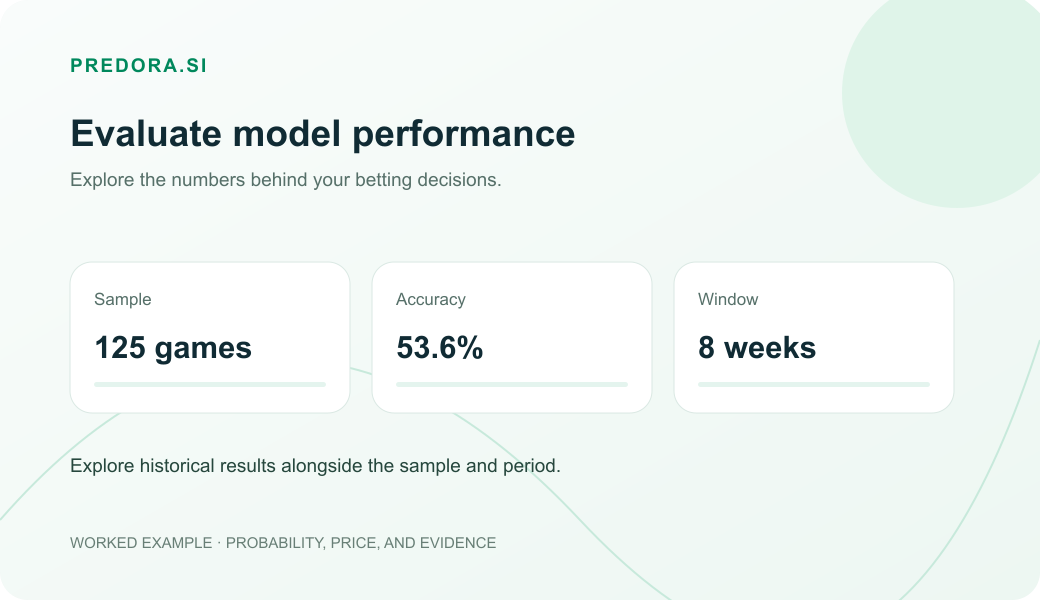
On Predora.si, hit rate appears in the Active Model, in Performance, and in Hit History. It helps understand consistency by market, league, and filter.
- Use it alongside the base to avoid conclusions from a small sample.
- Compare with Return to contextualize hit rate within the same filter.
- Separate by market, because 1X2, goals, BTTS, and corners behave differently.
Hit rate is not return
Hit rate shows frequency. Return shows economic outcome. In value betting, both need to be read together.
| Metric | What it shows |
|---|---|
| Accuracy rate | How many selections won. |
| Return | How much the strategy yielded or lost as a percentage. |
| EV | Mathematical expectation before the bet. |
Common mistakes
Confusing a high hit rate with profit
Hitting often at low odds may not offset a short losing streak.
Ignoring the sample
80% in 10 matches is very different from 58% in 500 matches.
Comparing different markets as if they were the same
Double Chance hit rate tends to behave differently from 1x2 or corners.
Practical checklist
- Check how many selections make up the sample.
- Check which market and league are filtered.
- Compare hit rate with return.
- Check the average odds or the price of the picks.
- Avoid strong conclusions from a small sample.
FAQ about Accuracy rate
Is hit rate the same as profit?
No. Hit rate measures the frequency of wins. Profit or return depends on the odds and the financial outcome.
Is a high hit rate always better?
Not necessarily. If the odds are too low, a high rate may not generate good return.
How do you calculate hit rate?
Divide the number of wins by the total picks and multiply by 100.
Why does the sample matter?
Because small samples fluctuate a lot. A high rate in a few matches may not hold up.
Where do I see hit rate on Predora.si?
In the Active Model card, in Performance, and in the models' Hit History.
Hit rate is only half the story
Hit rate is useful for measuring consistency, but it needs to go hand in hand with return, odds, and base. In betting, hitting more isn't enough if the price doesn't compensate.