Direct answer
Fair price is the odds that would make sense for an outcome based on an estimated probability. In football betting, it shows what price would be balanced before comparing it with the bookmaker's odds.
If the bookmaker pays above of the fair price, there may be value. If it pays below, the odds may even seem likely, but the price tends not to be worthwhile.
Quick summary
| Also called | Fair odds, correct odds, or fair price. |
|---|---|
| Formula | Fair price = 1 ÷ estimated probability |
| Used for | Compare the bookmaker's odds with the chance estimated by the model. |
| Sign of possible value | Bookmaker's odds above the fair price. |
| Common mistake | Comparing fair price without reviewing the estimate. |
| On Predora.si | Appears in the comparison between probability, best odds, EV, and estimated difference. |
Fair price is the odds consistent with the estimated probability for an outcome or market.
How it works
Think of fair price as the balanced price of a bet. If a model estimates that an outcome has 50% chance, the fair odds would be 2.00. If the bookmaker offers 2.30, it is paying more than this probability suggests.
Now, if the model estimates 50% and the bookmaker offers 1.70, the scenario changes: the odds are below the fair price. Even if the selection seems likely, the price may not be worthwhile.
In plain Portuguese:
- estimated probability becomes fair price;
- bookmaker's odds becomes implied probability;
- the comparison between the two shows whether there is estimated difference.
Fair price formula
Use the probability in decimal format, not percentage.
Fair price = 1 ÷ estimated probabilityImplied probability = 1 ÷ bookmaker's oddsEV = (estimated probability × odds) − 1| Estimated probability | Decimal format | Fair price |
|---|---|---|
| 60% | 0,60 | 1,67 |
| 58% | 0,58 | 1,72 |
| 55% | 0,55 | 1,82 |
| 50% | 0,50 | 2,00 |
| 48% | 0,48 | 2,08 |
Example in football
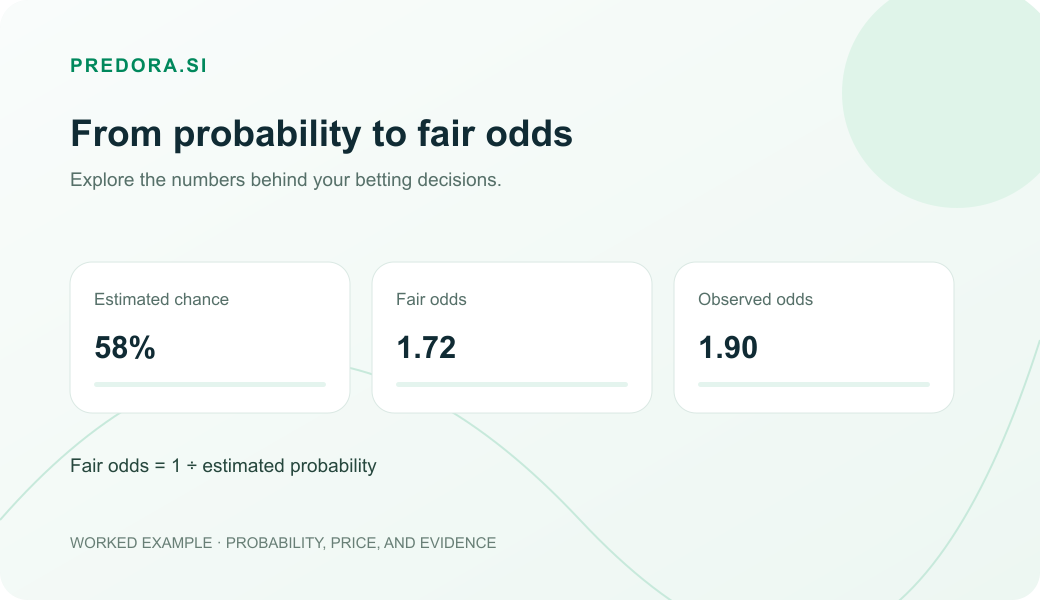
Imagine a Brasileirão Série A match in the market 1x2. The model estimates that the home team wins in 58% of the time in similar scenarios.
Fair price = 1 ÷ 0.58 Fair price = 1.72| Scenario | Bookmaker odd | Reading |
|---|---|---|
| Bookmaker paying 1.60 | Below 1.72 | Poor price for this probability. |
| Bookmaker paying 1.72 | Equal to fair | Balanced price. |
| Bookmaker paying 1.90 | Above 1.72 | There may be value. |
If the bookmaker offers 1.90 for something the model thinks is fair at 1.72, it is paying above the estimated price. This doesn't mean it will win; it means the price is interesting according to this reading.
How fair price connects with EV
Fair price helps you see value. The EV quantifies that value as a number.
Estimated probability = 58% or 0.58 Bookmaker's odds = 1.90 EV = (0.58 × 1.90) − 1 EV = 1.102 − 1 EV = +0.102 EV = +10.2%In that case, the bet would have positive EV according to the probability used.
- if the bookmaker's odds are above the fair price, the EV tends to be positive;
- if the bookmaker's odds are below the fair price, the EV tends to be negative;
- if it is very close, the decision depends on margin, context, market, and quality of the estimate.
Fair price, fair odds, and implied probability
In practice, fair price and fair odds point to the same idea: the odds consistent with an estimated probability.
| Term | Most common use |
|---|---|
| Fair price | Language close to trading and pricing. |
| Fair odds | Most common language in betting. |
| Correct odds | A didactic way of saying odds without margin, based on probability. |
The implied probability looks at the bookmaker's side: it is the chance embedded in the offered odds.
| Concept | Where it comes from | Formula |
|---|---|---|
| Fair price | Probability estimated by the model. | 1 ÷ estimated probability. |
| Implied probability | Odds offered by the bookmaker. | 1 ÷ bookmaker's odds. |
Model estimates 55% Fair price = 1 ÷ 0.55 = 1.82 Bookmaker offers odds of 2.05 Implied probability = 1 ÷ 2.05 = 48.8%Here the model is saying 55%, while the bookmaker is pricing it as something close to 48,8%. This difference is where the edge.
How it appears on Predora.si
On Predora.si, fair price comes into the value reading when the app compares five points:
- Active Model probability for the selected market.
- Fair odds or fair price derived from that probability.
- Best available odds among the monitored bookmakers.
- EV to measure mathematical expectation.
- Edge to measure the edge between model and bookmaker price.
Upcoming Matches
Helps explore matches, markets, odds, chance, and EV before opening a deeper analysis.
Odds Comparison
Shows where the best quote is for the same market and the same line.
Upcoming Games with EV+
Organizes scenarios in which the model estimates positive EV.
AI + Statistics
Helps assess whether the mathematical reading makes sense in the context of the game.
The idea is not to follow odds on autopilot. It is to use fair price as a reference to interpret the price difference.
Common mistakes
1. Skipping the probability behind fair price
Fair price is not a nailed-down prediction. An outcome with 60% chance can still fail to happen in 40% of cases.
2. Compare different markets
Don't compare the fair price of Home Win with the odds of Double Chance, Over 2.5, or Both Teams to Score. The comparison needs to be in the same game, market, selection, and line.
3. Looking only at high odds
High odds are not automatically a good price. Without an estimated probability, the odds are just a pretty number on the screen.
4. Ignoring that odds change
A divergence observed at 10am may no longer exist at 10:15am. EV depends on the odds available at that moment.
Practical checklist
- Choose the right market. E.g.: 1x2, Double Chance, Over 2.5 goals, Both teams to score or Over 9.5 corners.
- See the estimated probability. This is the basis of the calculation.
- Calculate the fair price. Use
1 ÷ estimated probability. - Compare it with the bookmaker's odds. If the odds are above the fair price, there may be value.
- Check the EV and the context. Positive EV helps, but it is still worth comparing factors, league, team form and sample quality.
Start with the fair odds, convert the bookmaker's odds into implied probability and use EV to measure whether the difference is really worth it.
FAQ about fair price
Is fair price the same thing as fair odds?
Yes. In betting, fair price, fair odds and correct odds usually point to the same idea: the odds consistent with an estimated probability.
What do odds above fair price indicate?
They indicate positive EV under the probability estimate used. Compare match factors, model history, and current odds to assess the opportunity.
How do I use fair price to evaluate odds?
Fair price translates a probability estimate into break-even odds. Compare it with the bookmaker’s quote to measure potential value.
Does the fair price change?
Yes. It changes when the estimated probability changes. If you switch the model, the market or your reading of the game, the fair price can also change.
Can I use fair price in any market?
Yes, as long as there is an estimated probability for that market. The reading must always respect the game, market, selection and line selected.
Next steps
Fair price gives you a clear reference for evaluating odds. Compare the bookmaker’s quote with the price implied by your estimate.
In football, where variance is high and a single moment changes everything, the most important thing is to repeat good decisions over the long term. Predora.si helps in this process by cross-referencing the Active Model probability, best available odds, EV and statistical factors.