Direct answer
Estimated probability is the chance calculated by a model, statistical analysis, or your own method for a scenario to happen in a football market.
No Predora.si, it appears as the chance of the Active Model for the selection in the selected market. This chance is the basis for calculating fair odds, edge and EV.
Quick summary
| Definition | Estimated chance of a result or market happening. |
|---|---|
| Example | A model estimates a 55% chance for the home team to win. |
| Used for | Calculate fair odds, EV, edge, and compare with the bookmaker's odds. |
| It is not | A price reference derived from the model’s probability estimate. |
| Common mistake | Thinking that a high probability always implies positive EV. |
| On Predora.si | It is calculated by the Active Model within the selected market. |
Estimated probability is the chance that the model assigns to a selection within a specific market, before comparing that chance with the available odds.
How it works
In practice, estimated probability is a mathematical reading of the game. Instead of looking only at the bookmaker's odds, you try to answer:
What is the realistic chance of this scenario happening?
Are the available odds paying well for this chance?
This estimate can come from a predictive model, a statistical analysis, or a combination of factors such as team performance, home advantage, recent form, goals, corners, league context, and history.
In football, it always needs to be read within a specific market. The same match can have one probability for 1x2, another for Over 2.5 goals, another for Both teams to score, and another for corners.
Examples by market
| Market | What the probability estimates |
|---|---|
| 1x2 | Chance of home win, draw, or away win. |
| Double Chance | Chance of 1X, X2, or 12. |
| Over 2.5 goals | Chance of the game having 3 or more goals. |
| Both Teams to Score | Chance of both teams scoring. |
| Over 9.5 corners | Chance of the match going over the corner line. |
Formulas that use estimated probability
Estimated probability itself does not have a single formula, because it is the output of the model or analysis. The important point is how it feeds into value calculations.
Fair odds = 1 ÷ estimated probabilityEV = (estimated probability × odds) − 1Edge = estimated probability − implied probabilityUse the probability in decimal format in the calculation. For example: 55% = 0,55.
Example in football
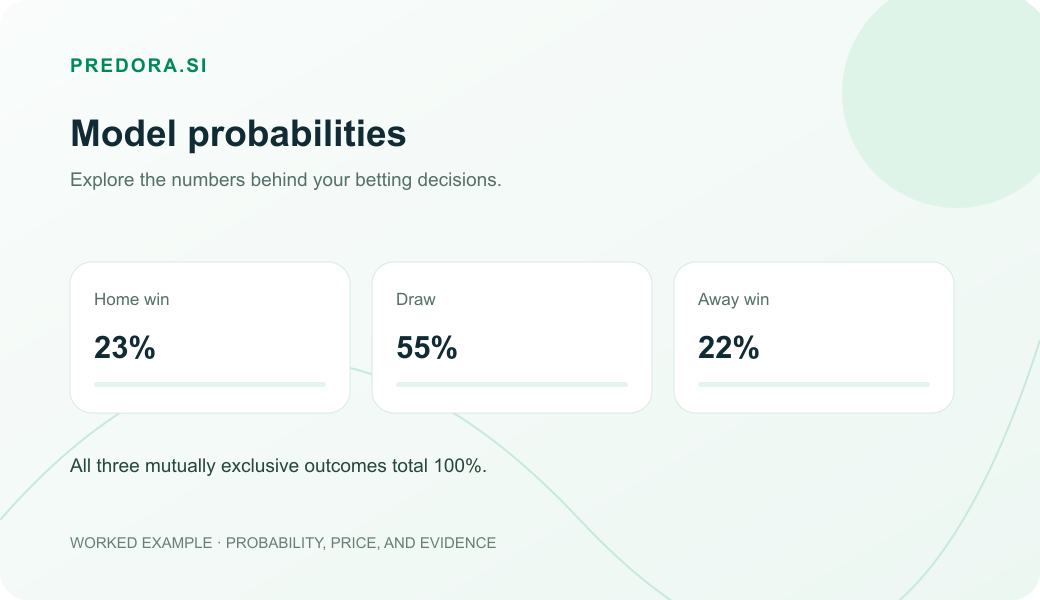
Imagine a hypothetical Brasileirão game in the market 1x2. The model estimates:
| Outcome | Estimated probability |
|---|---|
| Home team wins | 55% |
| Draw | 26% |
| Away team wins | 19% |
For the home team win, the estimated probability is 55%. The fair odd would be:
Fair odds = 1 ÷ 0.55 Fair odds = 1.82If a bookmaker is paying 2.05 for the home team to win, the odds are above the estimated fair odds.
EV = (0.55 × 2.05) − 1 EV = 1.1275 − 1 EV = 0.1275 EV = +12.75%In this example, according to the probability estimated by the model, the odds would have positive EV. This doesn't mean the bet will win. It means that, if the estimate is well calibrated, that price may be above fair value.
Estimated probability vs implied probability
These two terms interact all the time, but they are not the same thing.
| Concept | What it means | Where it comes from |
|---|---|---|
| Estimated probability | Chance calculated by a model or analysis. | Model, statistics, or bettor's method. |
| Implied probability | Chance embedded in the bookmaker's odd. | Odds offered by the bookmaker. |
Model's estimated probability = 55% Bookmaker odds = 2.05 Implied probability = 1 ÷ 2.05 = 48.78%Here, the model estimates 55%, but the bookmaker is pricing it as if it were about 48,78%. This difference is where the estimated difference.
How it appears on Predora.si
On Predora.si, estimated probability appears as Chance (%) in the games, always calculated by the Active Model and always within the selected market.
1. Upcoming Games shows chance by market
The grid helps you explore matches, markets, odds, and estimated chance before opening a deeper analysis.
2. Upcoming Games with High Probability organizes higher probability
The flow organizes games in which the Active Model points to a higher probability for the selected selection.
3. Upcoming Games with EV+ crosses chance and price
The page uses estimated probability and the best available odds to organize scenarios with positive EV.
4. AI + Statistics contextualizes the estimate
The game factors allow you to interpret convergences and divergences between form, attack, defense, and history.
Think of estimated probability as the starting point of the analysis. The next question is: are the odds paying well for this probability?
Common mistakes
1. Judging a probability estimate by one result
An estimated 60% chance also implies a 40% chance of the other outcome. Compare many similar predictions to assess calibration.
2. Confusing high probability with value bet
A selection can have a 70% chance and still be bad if the odds are too low. Chance helps, but price also matters.
3. Comparing probabilities from different markets
A 58% chance in Double Chance should not be directly compared with 58% in Over 2.5 goals. Each market answers a different question.
4. Ignoring the odds
Estimated probability without odds is only half the story. To know whether there is value, you need to compare estimated chance and offered price.
5. Not contextualizing the game scenario
Even with a good probability, it is worth checking factors, team form, chosen market, sample, and available odds before deciding.
Quick checklist
- Check which market is selected.
- See the estimated probability of the selection.
- Calculate or check the fair odds.
- Compare with the best available odds.
- See if there is a positive edge.
- Check whether the EV is positive.
- Compare factors, statistics, and context before the decision.
Start with the Active Model, see the Chance (%) in the chosen market, and compare with fair odds, EV, and the best available odds.
FAQ about estimated probability
Is estimated probability the same thing as implied probability?
No. Estimated probability comes from the model or analysis. Implied probability comes from the bookmaker's odds. Comparing the two helps you understand whether the odds may be paying well.
Does high estimated probability imply positive EV?
Not necessarily. EV depends on probability and price. If the odds are too low, a selection with a high chance can have negative EV.
Who calculates the estimated probability on Predora.si?
On Predora.si, the Active Model calculates the estimated probability. It can be a house model or a custom model, depending on what the user has selected.
Why does the probability change when I switch markets?
Because each market asks a different question about the game. The chance of a team winning is not the same as the chance of Over 2.5 goals or Both Teams to Score.
Why does the probability change when I switch models?
Because each model uses a different mathematical lens. When you switch the Active Model, the reading of the game can change, and this also changes fair odds, edge, and EV.
Next steps
Want to dig deeper into the full reasoning? Read about the Active Model to understand where the probability comes from, then compare fair odds, EV, and implied probability in the same reading.
Want to calculate it in practice? Use the EV Calculator to test an estimated probability against the available odds.