Direct answer
Bankroll in betting is the money set aside exclusively for betting, without mixing it with everyday accounts. It works as an exposure reference: the unit and the stake express exposure on a consistent scale over time.
In one sentence: bankroll is the monetary base used to express unit, stake, and bankroll variation on a common scale.
Quick summary
| Definition | Money set aside only for betting. |
|---|---|
| What it's for | Relate unit, stake, and bankroll variation on the same scale. |
| Useful formula | Bet unit = bankroll × defined percentage |
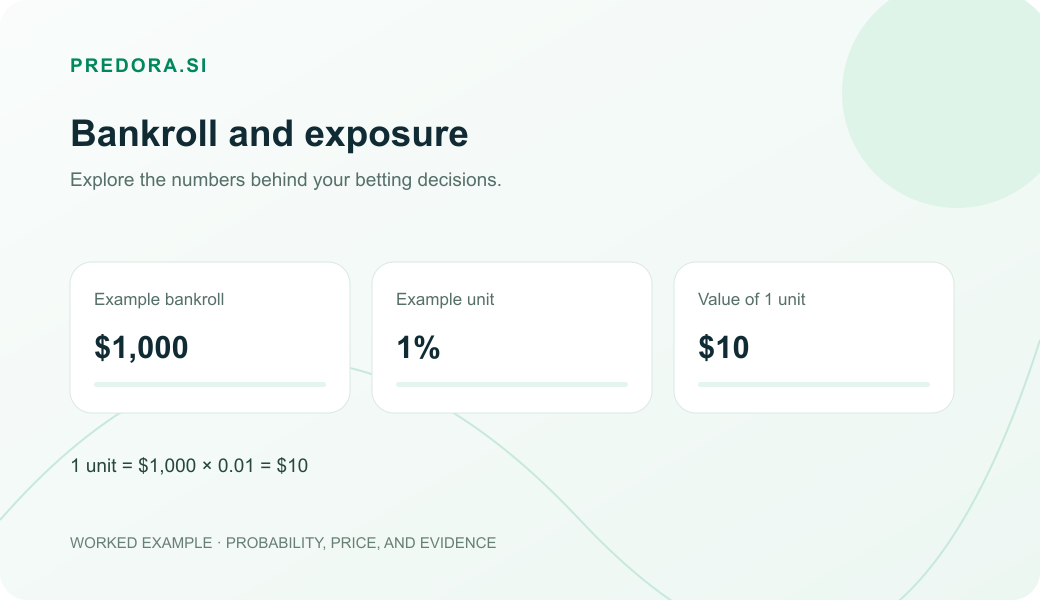
| Example | Bankroll of $1,000 with a 1% unit = $10 per bet. |
| Common mistake | Confusing recent results with the exposure formula. |
| How Predora.si helps | Helps analyze chance, EV, best odd, history, and context. The bankroll remains the user's responsibility. |
Bankroll, unit, and stake describe the scale of exposure. None of these measures changes the probability, the EV, or the outcome of a game.
How does a bankroll work in betting?
The bankroll works as the calculation base for observing an inevitable part of betting: variance. Even in series with estimated probability, fair odds and EV, results fluctuate.
In football, a missed goal, a red card, a questionable penalty, a shot off the post, or a goalkeeper having a great day can disrupt the short term. The bankroll scale makes it possible to quantify the impact of these fluctuations without explaining their cause or predicting the next result.
- Bankroll: monetary base of the example.
- Unit: standardized percentage of that base.
- Stake: exposure recorded in a scenario.
- Variance: observed fluctuation between results.
- Sample: set used to interpret the metrics.
Formula to connect bankroll and unit
There is no mandatory formula for bankroll. The relationship below only shows how a hypothetical percentage can be expressed as a monetary unit.
Bet unit = bankroll × defined percentageStandard stake = unit used in the entryBankroll = $1,000 Percentage per bet = 1% Unit = 1,000 × 0.01 Unit = $10With a bankroll of $900, a hypothetical 1% unit equals $9. With a bankroll of $1,100, the same percentage equals $11. The calculation describes proportion; it does not recommend a percentage or bet amount.
Example in football
Consider a simulation with a bankroll of $800 and a hypothetical unit equivalent to 1% of bankroll.
Bankroll = $800 Unit = 1% Standard stake = $8At Predora.si, a scenario appears in Upcoming Games with EV+ for a Brasileirão game in the market Over 2.5 goals. The Active Model shows positive EV, odds above the estimated fair price and associated statistics.
In this example, a 1% exposure equals $8 and a stake of $30 equals 3.75% of the bankroll. These figures let you compare the effect of different stakes on the same scale.
Bankroll, unit, and stake: what is the difference?
| Term | What it means | Example |
|---|---|---|
| Bankroll | Total amount set aside for betting. | $1.000 |
| Bet unit | Standard percentage of the bankroll used to measure entries. | 1% of bankroll |
| Stake | Amount placed on a specific bet. | $10 on a bet |
In comparative terms, bankroll is the total base, unit is the ruler, and stake is the recorded exposure. This distinction makes it possible to relate sequence, sample, and variance on the same scale.
How does bankroll connect with value betting?
Value betting and bankroll management work together, but they are not the same thing. A bet can have positive EV while individual results vary. EV measures an expected average; bankroll management shows how those results affect your balance.
Bankroll defines the monetary base of the comparison.
Unit and stake express exposure; they do not change the chance of the game.
Bankroll helps measure fluctuations. In a series of scenarios with estimated value, some hit and others lose. Bankroll control highlights the effect of a bad sequence on the scale.
How it appears on Predora.si
Predora.si does not manage your bankroll, does not accept bets, does not process deposits, and does not pay prizes. The bankroll stays outside the app and remains the user's responsibility.
Predora.si organizes the following analytical dimensions:
1. Upcoming Games with EV+
Shows games where the Active Model points to positive EV.
2. Upcoming Games
Helps compare chance, EV, event, selection, and best odd.
3. Performance
Compares Base, Hit Rate, and Return across leagues.
4. History and factors
Organizes base, simulation, hit rate, context, and statistics for comparison.
In summary: Predora.si organizes scenarios for analysis. Bankroll, unit, and stake describe the size of the recorded exposure.
Common mistakes
1. Confusing bankroll with recent results
Bankroll is the basis of the calculation; a recent streak does not change its mathematical definition.
2. Mixing price analysis with stake sizing
Positive EV indicates possible estimated value in the long run, but a specific bet can still lose.
3. Comparing stakes on different scales
Absolute values without the reference bankroll do not allow comparing proportional exposure.
4. Inferring a pattern from a single result
A single observation does not represent the sample distribution nor separate outcome from process.
5. Mixing personal money with betting money
In the educational definition, bankroll is a specific base, distinct from other financial categories.
Points for interpreting bankroll and exposure
- Monetary base: what value serves as the reference for the calculation?
- Percentage: what proportion of the base does the example represent?
- Common unit: are the scenarios expressed on the same scale?
- Price and chance: probability, fair odds, and EV are metrics separate from stake.
- Variance: individual results may diverge from the estimated expectation.
- Sample: does the sample have enough observations for comparison?
The bankroll management guide compares bankroll, unit, stake, and variance through definitions, formulas, and simulated scenarios.
FAQ about bankroll in betting
Is bankroll the same thing as balance at the bookmaker?
Not necessarily. The balance at the bookmaker is the money inside a specific platform. The bankroll is the total amount set aside for betting, even if it is split across several bookmakers or still outside them.
Is there a universal bankroll size?
No. The definition describes a monetary base; it does not establish or recommend a value. The examples on this page are only simulations.
Does subjective confidence change the stake calculation?
It does not change the formula. Stake and unit quantify exposure, while probability, odds, and EV describe other dimensions of the scenario.
Does positive EV determine the stake size?
EV evaluates price against probability. Stake sizing is a separate calculation that shows how much of your bankroll a bet represents.
Does Predora.si manage my bankroll?
No. Predora.si is an analysis and comparison platform for football betting. Bankroll management and the amount wagered remain the user's responsibility.
Next steps
In an analysis routine, bankroll, unit, price, EV, odds, Performance, and context are complementary and independent dimensions.
Bankroll provides a common base for measuring stakes, returns, and fluctuations across a series of bets.