Direct answer
Negative EV is when the expected value of a bet falls below zero. In practice, it means that the The offered odds do not compensate for the estimated probability for that selection.
The selection can still hit. The point is different: under the probability used, the available price produces a below-zero EV.
Quick summary
| Term | Negative EV |
|---|---|
| Meaning | Expected value lower than zero. |
| Formula | EV = (estimated probability × odds) − 1 |
| Practical reading | The odds are paying less than they should for that chance. |
| Common mistake | Thinking that a negative EV means the bet cannot win. |
| How Predora.si helps | Shows Chance, odds, and EV to compare the observed price with the estimated fair price. |
A negative EV indicates that the odds are below the estimated fair price: the selection can hit, but the price does not compensate for the probability used in the calculation.
How it works
The EV, or expected value, compares two things:
- The estimated probability of a selection happening.
- The odds that the bookmaker is offering for that selection.
When the result is negative, the model is saying that the odds are too low for that chance. The problem is not necessarily the selection. The problem is the price.
The selection can hit in a single event.
But the odds are too low for the estimated probability.
Negative EV formula
EV = (estimated prob. × odds) − 1EV (%) = EV × 100| Estimated probability | The selection's chance according to the model, used in decimal form. E.g., 60% = 0.60. |
|---|---|
| Odds | The decimal price offered by the bookmaker for the analyzed market. |
| Negative EV | It happens when the formula result is lower than zero. |
EV < 0 = negative EVExample in football
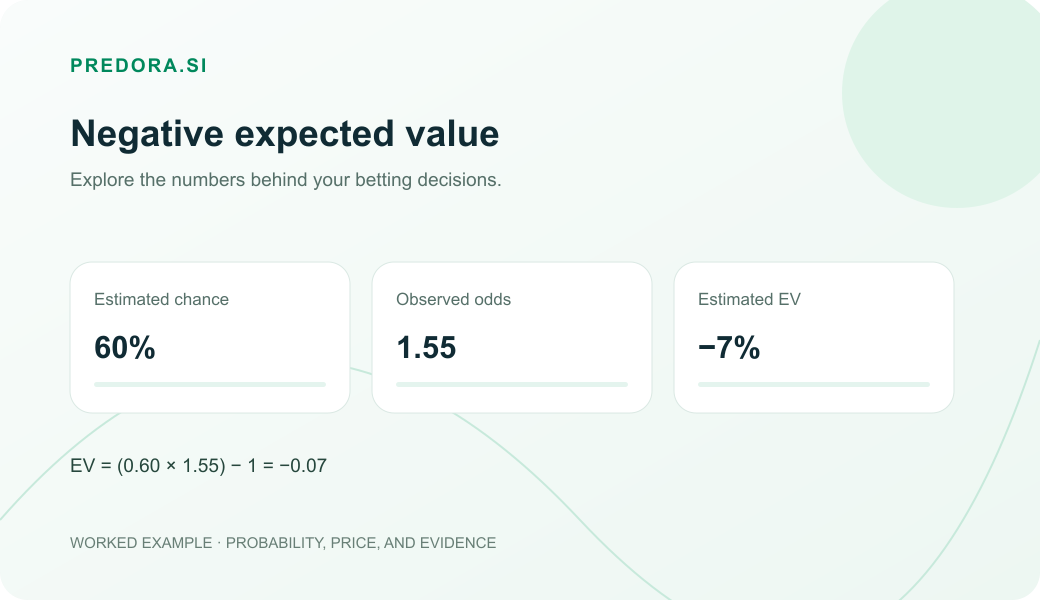
Imagine a Brasileirão match in which the model estimates the market home team wins as follows:
| Estimated probability | 60% |
|---|---|
| Bookmaker odd | 1.55 |
| Approximate fair odds | 1 ÷ 0.60 = 1.67 |
EV = (0.60 × 1.55) − 1 EV = 0.93 − 1 EV = -0.07 EV = -7%The estimated chance is high, but the odds 1.55 are paying too little for a probability of 60%. If the fair odds would be close to 1.67, the offered price is below the ideal. That is where negative EV is born.
Negative EV is not an impossible bet
This is the most important point: a bet with negative EV can still win. Football has variance, a scrappy goal, a penalty, a red card, an inspired goalkeeper, and many situations that change a game.
What negative EV does not say:
Negative EV does not predict the outcome of a single event.
What it says:
At the offered price, the calculated EV is negative for the probability used.
In other words: Understand what negative EV says about price.
Difference between negative EV and positive EV
| Concept | What it means | Practical reading |
|---|---|---|
| Negative EV | The odds pay less than they should for the estimated probability. | Price below the estimated fair value. |
| Zero EV | The odds are close to the break-even point. | Estimated difference close to zero. |
| positive EV | The odds pay above what they should for the estimated probability. | There may be an estimated difference. |
In football, it is not enough to ask which team has the better chance. The most useful question is:
Are the odds paying well for this chance?
When can a high chance still have negative EV?
This happens when the bookmaker also sees that scenario as likely and drops the odds.
Estimated probability = 70% Offered odds = 1.35 EV = (0.70 × 1.35) − 1 EV = 0.945 − 1 EV = -0.055 EV = -5.5%The selection has a high chance, but the odds are below the estimated fair price for that probability.
How it appears on Predora.si
In the Predora.si, the EV appears alongside the Chance (%), the market, and the selection in the Active Model.
1. Upcoming Matches shows the full reading
You can compare matches with positive, neutral, or negative EV without looking only at chance.
2. Upcoming Matches with EV+ organizes scenarios with positive EV
The list compares scenarios in which the model points to a price above the estimated fair value.
3. High chance does not automatically become value
A favorite can appear with a high chance and low or negative EV when the odds are too tight.
4. The Active Model changes the calculation
If the estimated probability changes, the EV can also change. The reading depends on the selected model.
This detail is important: high probability is not automatically a value bet.
Common mistake
1. Thinking that negative EV means a certain loss
It does not. A bet with negative EV can win today, but the price does not seem favorable for repetition.
2. Looking only at chance
A bet with a 75% chance can be bad if the odds are too low for that probability.
3. Ignoring the fair odds
Without comparing the offered odds with the estimated fair price, it is hard to know whether there is value.
4. Not recalculating when the odds change
EV depends directly on the available odds. If the price drops, a neutral reading can turn negative.
Practical checklist
- See the estimated probability by the model for that market.
- Compare with the available odds for the same market and the same line.
- Calculate the fair odds using
1 ÷ probability. - Calculate the EV with
(probability × odd) − 1. - Check whether the EV is negative, neutral, or positive.
- Compare the context with factors, market, league, form, and statistics.
- If the price does not compensate, another odds will produce a different mathematical result.
Use the EV Calculator to test the relationship between your estimated probability and the available odds in the same reading.
FAQ about negative EV
Does negative EV mean the bet will lose?
No. Negative EV does not predict a loss. It indicates that the odds are below the fair price for the estimated probability. The selection can still hit in a single event.
Can a bet with a high chance have negative EV?
Yes. This happens quite often with favorites. The chance can be high, but if the odds are too low, the expected value becomes negative.
What does negative EV describe?
It describes a relationship in which the observed odds are below the estimated fair price for the probability used. It does not predict the isolated outcome or determine an action.
What is the difference between negative EV and low odds?
Low odds are just the price. Negative EV is the mathematical conclusion after comparing that price with the estimated probability. Not every low odds is automatically bad, but many low odds can generate negative EV.
How does a change in odds alter the EV?
The calculation changes when the odds or the estimated probability change. If the observed odds remain below the fair odds, the EV stays negative for that estimate.
Closing
Negative EV does not mean the bet cannot win. It means that, at the offered price, the odds do not compensate for the estimated probability.
In practice, this is an invitation to take a breath, compare price and chance, and see how another odds would change the mathematical result.